About Leptospermum liversidgei R.T.Baker & H.G.Sm.
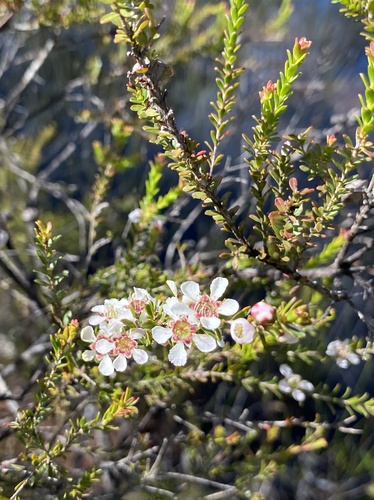
Leptospermum liversidgei R.T.Baker & H.G.Sm. is a shrub that usually reaches 4 meters (13 feet) in height. It has thin, rough bark on its main branches, and its young stems are hairy. The leaves are crowded, narrow egg-shaped, lemon-scented, and typically measure 5–7 mm (0.20–0.28 in) long and 1–2 mm (0.039–0.079 in) wide, borne on a very short petiole.
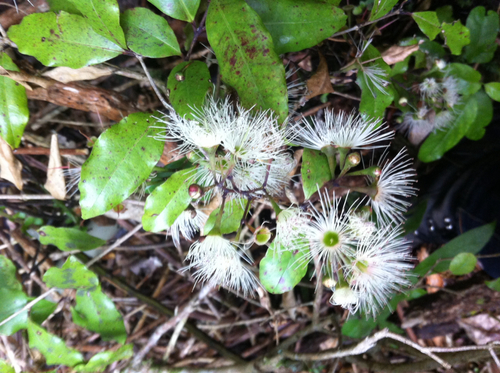
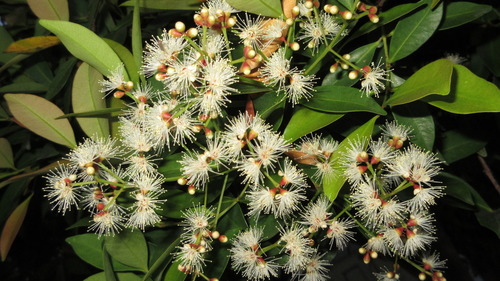
Its flowers are white or pink, 10–12 mm (0.39–0.47 in) wide, and grow on a 1–1.5 mm (0.039–0.059 in) long pedicel. Flowers are arranged singly on the tips of short, leafless side branches. The dark-coloured floral cup is around 2.5 mm (0.098 in) long; sepals are hemispherical to triangular, about 2 mm (0.079 in) long; petals measure about 5 mm (0.20 in) long; and stamens are 1.5–2.5 mm (0.059–0.098 in) long. Flowering occurs mainly in January. The fruit is a woody capsule 7–10 mm (0.28–0.39 in) wide, and is not shed once it reaches maturity.
This species, commonly called olive tea-tree, grows in coastal swamps in heath habitat, ranging from the Bundaberg region of Queensland to Tomago in New South Wales.
In horticulture, the size of this tea-tree makes it well-suited for smaller gardens. It tolerates poorly-drained soil and at least moderate frost. Its leaves contain the essential oil citronellal, and the plant is sometimes claimed to repel mosquitoes.