About Leptospermum grandifolium Sm.
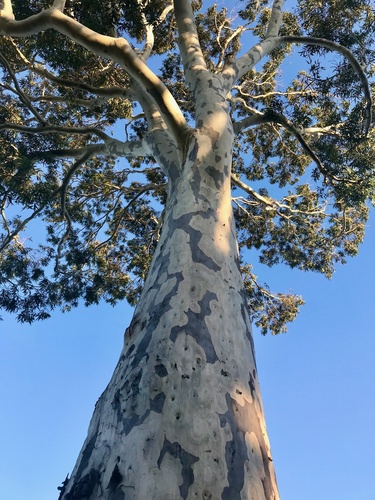
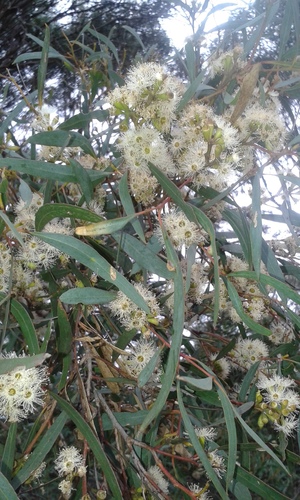
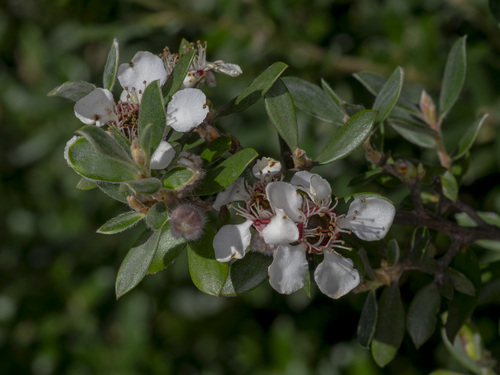
Leptospermum grandifolium Sm. is a woody plant that grows as a shrub around 1.5 metres (4 feet 11 inches) tall, or a tree reaching up to 10 metres (33 feet) tall. It has smooth bark that is shed in papery strips or flakes. Its leaves are narrow egg-shaped to elliptical, between 10 and 35 millimetres (0.39 to 1.38 inches) long and 3 to 7 millimetres (0.12 to 0.28 inches) wide, often with a felty texture. Each leaf has a small, sharp pointed tip, and its base tapers to a short petiole.
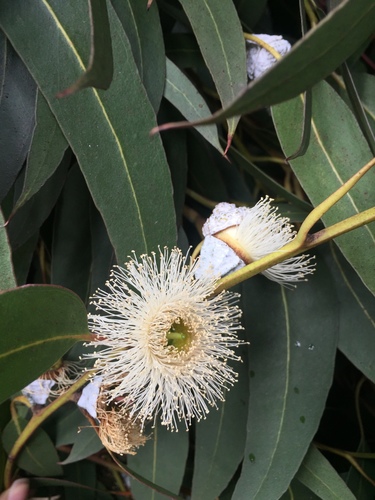
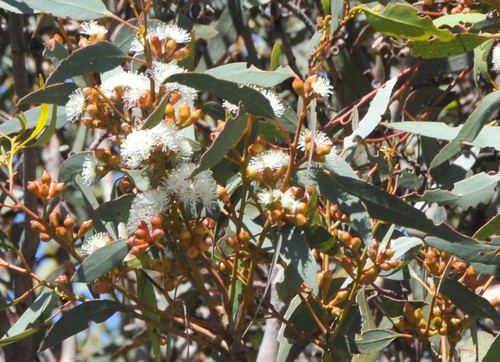
Flowers grow singly on short side shoots at the ends of leafy branchlets, and have a diameter of 12 to 18 millimetres (0.47 to 0.71 inches) or larger. The base of the flower bud has broad, pale brownish bracts and bracteoles. The floral cup is 3 to 5 millimetres (0.12 to 0.20 inches) long and is densely hairy. The sepals are egg-shaped to triangular, 3 to 4 millimetres (0.12 to 0.16 inches) long and also densely hairy. Petals are white, 4 to 7 millimetres (0.16 to 0.28 inches) long, and the stamens are around 3.5 millimetres (0.14 inches) long. Flowering occurs between October and January. The fruit is a hemispherical capsule 8 to 10 millimetres (0.31 to 0.39 inches) wide, which remains on the plant when mature with the sepals still attached.
Commonly called mountain tea-tree, this species is found in the eastern half of Victoria, the Australian Capital Territory, and south-eastern New South Wales, extending north as far as the Hawkesbury River. It grows in swamps, along rocky streams, and on sheltered slopes, from coastal areas up to the subalpine regions of Mount Kosciuszko.
Leptospermum grandifolium is one of several Leptospermum species valued for cultivation. The cultivar 'Silver Sheen' is hardy in mild and coastal areas of the United Kingdom, tolerating temperatures down to −5 °C (23 °F), but requires a sheltered growing position. This cultivar has received the Royal Horticultural Society's Award of Garden Merit.