About Leptosema chambersii F.Muell.
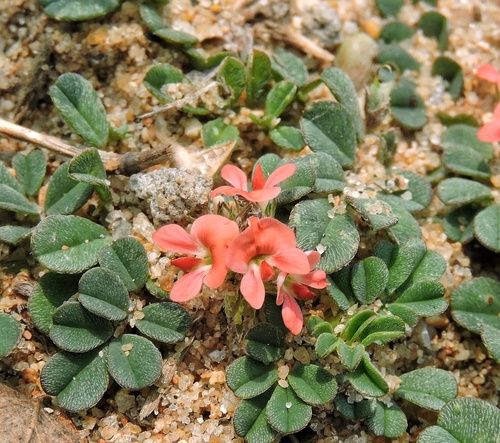
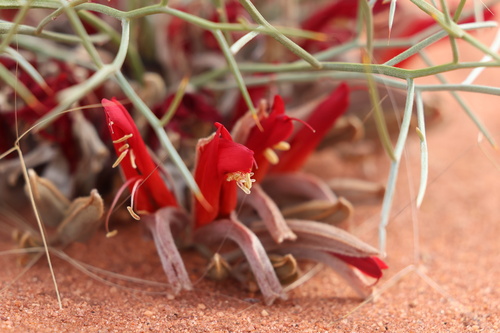
Leptosema chambersii is a low shrub that grows in small, dense clumps. It has many tangled branches and branchlets, and typically reaches up to 40 cm (16 in) in height. Its mature leaves are reduced to scales that are around 1.5 mm (0.059 in) long. The flowers are resupinate, and arranged in rosettes of 2 to 20 flowers at the base of the plant. Each flower grows on a 5–20 mm (0.20–0.79 in) long pedicel, with narrowly egg-shaped bracteoles that measure 1.5–3.5 mm (0.059–0.138 in) in length. The sepals are 28–34 mm (1.1–1.3 in) long, and form a tube that is about 4 mm (0.16 in) long. All petals are red; the standard petal is enclosed within the sepals, is 17–22 mm (0.67–0.87 in) long and 5–6 mm (0.20–0.24 in) broad. The wing petals are linear, 32–34 mm (1.3–1.3 in) long and 2–3 mm (0.079–0.118 in) wide. The keel protrudes, and is 38–40 mm (1.5–1.6 in) long. The ovary is more or less sessile, and holds about 60 ovules. Flowering mainly occurs between July and October. The seed pods are sessile and beaked, measuring 10–20 mm (0.39–0.79 in) long and 7–11 mm (0.28–0.43 in) wide including the beak. This species grows on red sand on sand dunes and sandplains in hummock grassland, that is mainly dominated by Triodia basedowii. It occurs in the Eremaean province of Western Australia, the southern half of the Northern Territory, and the north-western corner of South Australia.