About Leptopogon rufipectus (Lafresnaye, 1846)
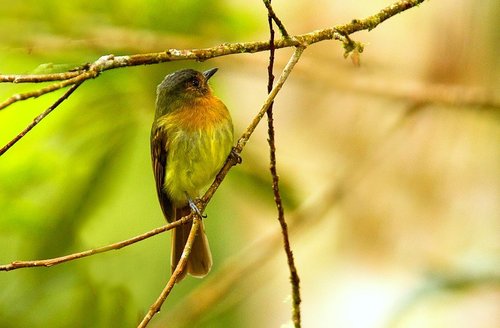
The rufous-breasted flycatcher, Leptopogon rufipectus (Lafresnaye, 1846), measures 13 to 13.5 cm (5.1 to 5.3 in) long. Six measured individuals weighed between 10 to 18 g (0.35 to 0.63 oz). Males and females have identical plumage. Adult individuals have a gray crown. Most of their face is rufous, with gray coloring on the lores and ear coverts, and a dusky crescent around the back of the ear coverts. Their back and rump are olive green. Their wings are dusky, with ochraceous or olive yellow edges on the flight feathers. Their wing coverts are dusky, with ochraceous tips that form two indistinct wing bars. Their tail ranges from reddish brown to brownish olive. Their throat and breast are rufous, and their belly is pale olive yellow. They have a brown iris, a black or dark brown bill, and gray or bluish gray legs and feet. The rufous-breasted flycatcher has a disjunct distribution. One population occurs from southern Táchira in western Venezuela, extending south along Colombia's Eastern Andes to western Caquetá Department. Two additional populations are found in Colombia's Central and Western Andes. It is patchily distributed (though possibly continuously distributed) along the east slope of the Andes from northern to central Ecuador, and again from southern Ecuador into northern Peru as far as the Marañón River. It inhabits the interior and edges of humid montane forest and secondary forest in the subtropical and lower temperate zones. Its elevation range is between 1,800 and 2,700 m (5,900 and 8,900 ft) in Venezuela, between 1,600 and 2,800 m (5,200 and 9,200 ft) in Colombia, mostly between 1,600 and 2,500 m (5,200 and 8,200 ft) in Ecuador, and between 1,650 and 2,150 m (5,400 and 7,100 ft) in Peru.