About Leptopogon amaurocephalus Tschudi, 1846
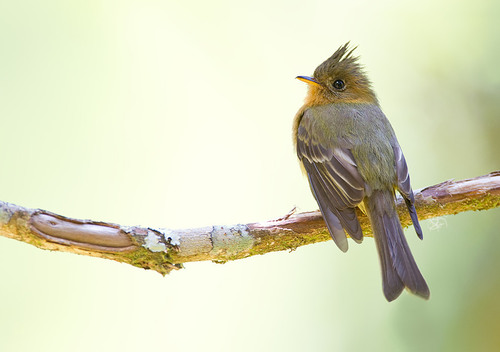
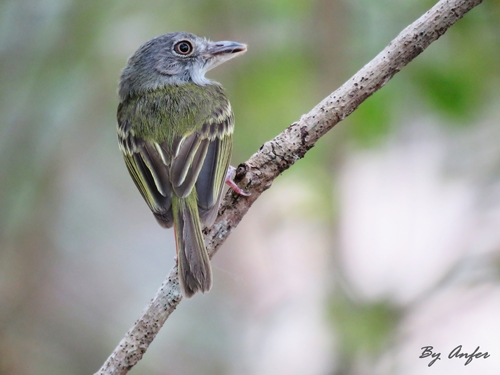
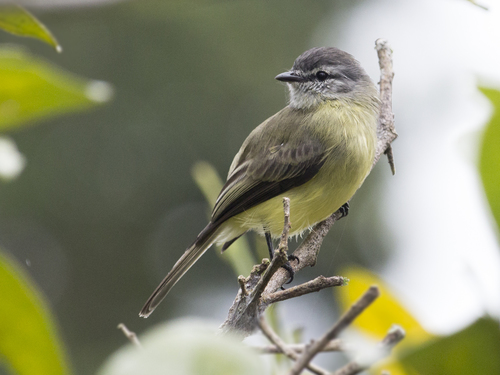
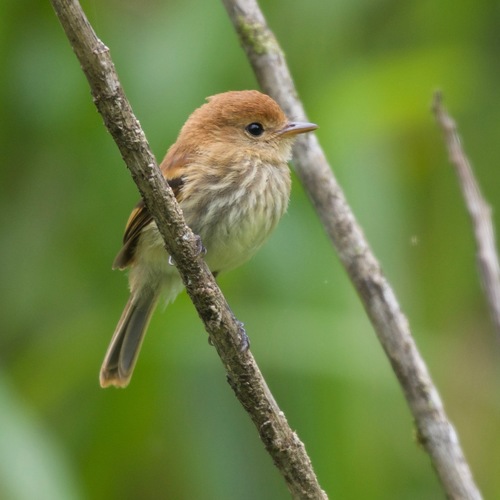
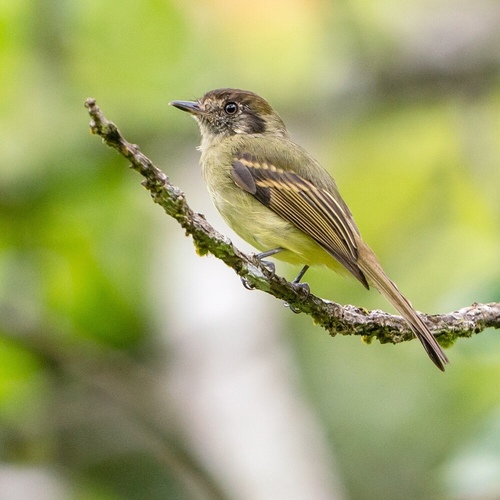
The sepia-capped flycatcher (scientific name Leptopogon amaurocephalus Tschudi, 1846) measures 11.5 to 14 cm (4.5 to 5.5 in) long, and weighs an average of about 12 g (0.42 oz). Males and females have identical plumage. For the nominate subspecies, L. a. amaurocephalus, adults have a sepia brown crown, a paler nape, dull yellowish olive lores with mixed dusky tones, and a dusky patch on the rear of their ear coverts. The rest of their face is light olive. Their back and rump are olive green, their uppertail coverts are russet brown, their wings are dusky with pale yellowish olive edges on flight feathers, and their wing coverts are dusky with buff to ochraceous buff tips that form two distinct wing bars. Their tail feathers are dull brown with paler brown edges. Their chin and throat are grayish olive with faint dull white streaks, their breast and flanks are light olive, and their belly ranges from yellowish white to yellow. Other subspecies differ from the nominate and each other as follows: L. a. pileatus is similar to the nominate, but has a strong warm cinnamon brown tinge on the uppertail coverts and tail feathers. L. a. idius is overall grayer, more grayish green on the upperparts, and paler yellow on the underparts than the nominate, lacks dark ends on the ear coverts, and has a strong warm cinnamon brown tinge on the uppertail coverts and tail feathers. L. a. diversus has a much darker brown crown and a paler yellow belly than the nominate, with buffy edges on the tail feathers. L. a. orinocensis has a darker crown and a less yellowish back than the nominate. L. a. peruvianus has a darker olive crown than the nominate, a dark grayish back and rump, and pale yellow edges on flight feathers and wing coverts. For all subspecies, both sexes have an iris that ranges from light brownish yellow to dark brown, a black or dark brown bill that sometimes has a pale base on the mandible, and legs and feet in various shades of gray. The sepia-capped flycatcher has a disjunct distribution, with subspecies occurring in separate ranges as follows: L. a. pileatus ranges from southern Veracruz, northern Oaxaca, and the Yucatán Peninsula in Mexico, south along the Caribbean slope through Belize, Guatemala, Honduras, and Nicaragua to central Costa Rica, and also occurs on the Pacific slope from central Costa Rica to central Panama. L. a. idius is found only on Coiba Island off southwestern Panama. L. a. diversus ranges from Colombia's Sierra Nevada de Santa Marta south through the Magdalena River valley, and east to Venezuela's Zulia state in the Serranía del Perijá. L. a. orinocensis occurs in western Venezuela from southern Táchira to Portuguesa state, and also ranges from central Amazonas and northern Bolívar states in Venezuela east through the Guianas and northern Brazil to the Atlantic coast in Amapá. L. a. peruvianus ranges from Colombia's Eastern Andes south through eastern Ecuador and eastern Peru into northern Bolivia, and extends east from there through Brazil from Amazonas and Rondônia east into northern Mato Grosso. The nominate subspecies L. a. amaurocephalus occurs in southern and eastern Brazil from Mato Grosso, Maranhão and Pernambuco south into Rio Grande do Sul, and west through eastern Bolivia and all of Paraguay into Argentina's northwestern Salta Province and northeastern Corrientes Province. Sight records in Uruguay have led the South American Classification Committee of the American Ornithological Society to list the species as a vagrant there. The sepia-capped flycatcher primarily inhabits lowland evergreen forest, mature secondary forest, and plantations in tropical and lower subtropical zones. In northern Central America it also lives in semideciduous forest, and in the llanos of Venezuela it inhabits gallery forest. Its elevational range varies by region: it occurs from sea level to 1,300 m (4,300 ft) in Mexico and Central America, up to 600 m (2,000 ft) in Colombia, and up to 1,100 m (3,600 ft) in Brazil. In Venezuela it is found between 100 and 600 m (300 and 2,000 ft) north of the Orinoco River, and up to 1,600 m (5,200 ft) south of the Orinoco. It reaches 450 m (1,500 ft) in Ecuador, 1,300 m (4,300 ft) in Peru, and 1,000 m (3,300 ft) in Bolivia.