About Leptophyes punctatissima (Bosc, 1792)
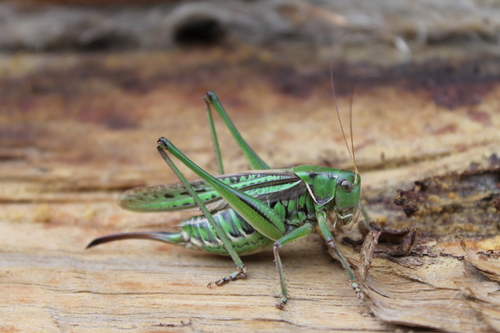
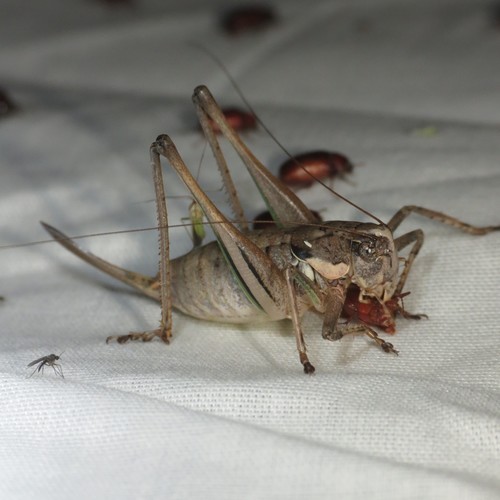
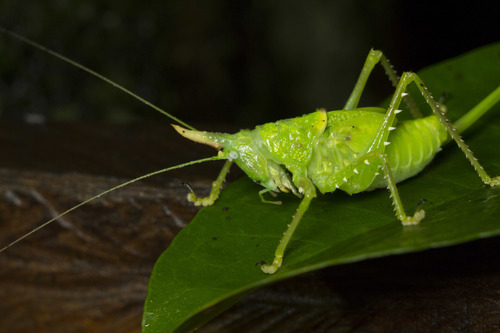
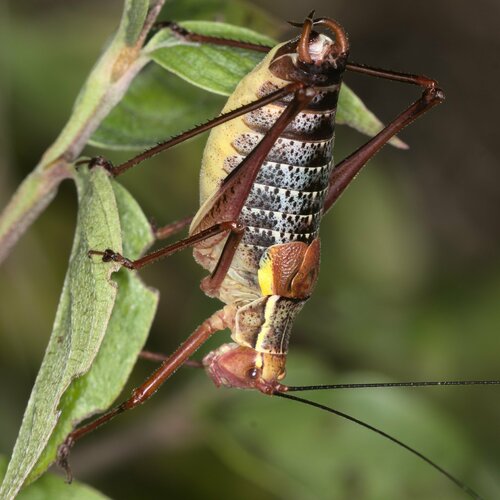
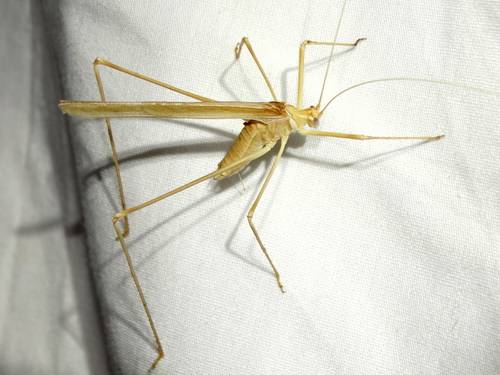
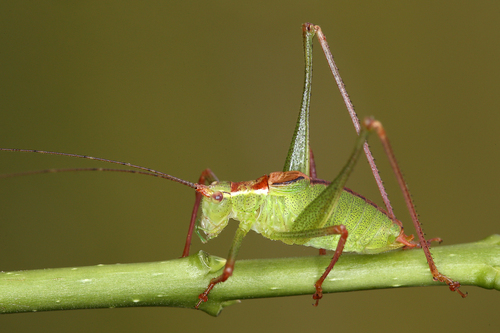
Leptophyes punctatissima, commonly known as the speckled bush-cricket, can reach a body length of about 10–15 mm (0.39–0.59 in). It is green with tiny black speckles covering its entire body, which are more visible in nymphs. This pattern is referenced in both the species' common name and scientific Latin name. Its green colouring and secretive habits, with the insect staying hidden in undergrowth, mean it often goes unnoticed. The dorsal (top) surface of its abdomen has an orange-brown stripe that is more prominent in males than in females. A yellow-white stripe stretches backwards from the insect's eyes. Its lower legs and feet are brownish. The antennae of the speckled bush-cricket are twice as long as its body. This species is brachypterous: male forewings are reduced to small flaps, and female forewings are even smaller. Hindwings are completely absent, so both males and females are flightless. The female's ovipositor is compressed from side to side and curves sharply upwards. The speckled bush-cricket is common across most of Europe. Its range extends west to the British Isles, France, Poland and Belgium, east to the European sections of Russia, north to southern Scandinavia, and south to southern Italy, Bulgaria and Greece. It has been recorded as far south as Israel, and it is also found in the Nearctic realm. This species lives mainly in dry shrubby environments, including open woodland, scrub, hedgerows, and gardens, where it is associated with birch, bramble, and gorse. Nymphs are found in low vegetation, while adults are more often located high up in trees. After reaching sexual maturity around early August, males and females call to locate one another. Once a pair meets, the female stays stationary while the male moves beneath her. If the female rejects the male, she simply moves away. During copulation, the male produces a spermatophore surrounded by an edible substance called a spermatophylax. Unlike the spermatophylax of other cricket species, this substance has no nutritional value. Instead, it is thought to protect sperm from being removed too early and distract the female from other males. It takes the female between 12 minutes and 2 hours to fully eat the spermatophore. Males do not mate again for at least 24 hours after mating. Females can begin laying eggs as early as the night after mating. They deposit their eggs into tree bark or plant stems. The total number of eggs a female lays, and how often she lays eggs over her lifespan, varies widely. For example, some individuals have been observed laying one egg per week, while others lay three eggs per day. Recorded lifetime totals for females range from 10 to 185 eggs.