About Leptonychotes weddellii (Lesson, 1826)
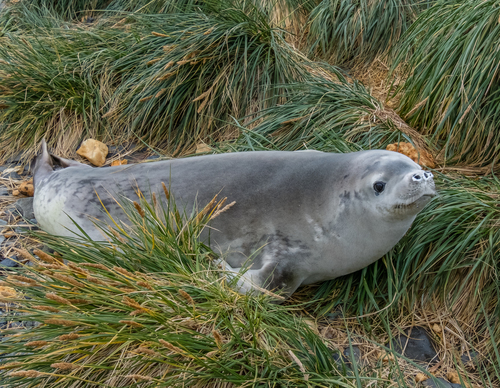
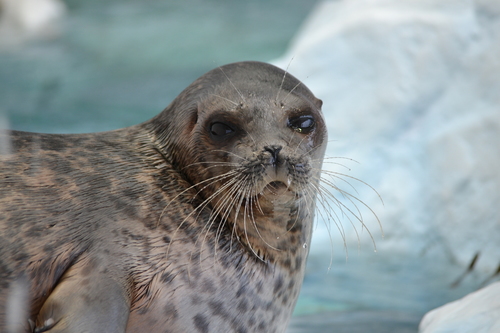
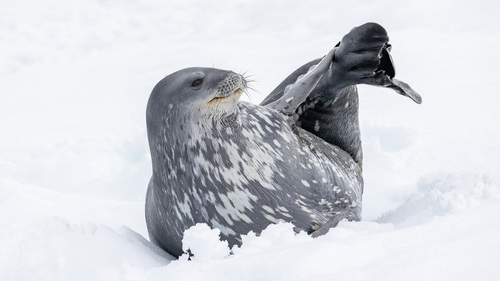
Weddell seals (Leptonychotes weddellii) measure about 2.5–3.5 m (8 ft 2 in – 11 ft 6 in) long and weigh 400–600 kg (880–1,320 lb). They are among the largest seals, with a fairly bulky body and short fore flippers relative to their body length. Males weigh less than females, usually about 500 kg (1,100 lb) or less. Male and female Weddell seals are generally around the same length, though females can be slightly larger. Males tend to have thicker necks, broader heads, and broader muzzles than females. A molecular genetic technique is available to confirm the sex of individual Weddell seals in a laboratory setting. The Weddell seal’s face has been compared to a cat’s face, due to its short mouth line and similarities in the structure of the nose and whiskers. Weddell seals grow a thin fur coat across their entire body, except for small areas around the flippers. The colour and pattern of the coat varies, and often fades to a duller colour as the seal ages. This coat moults around the start of summer. Adults have counter-shaded colouration, ranging from bluish-black to dark grey on the dorsal (back) side, and light grey to silver on the ventral (belly) side. Coats may turn shades of brown before the annual moult. Adult males usually have scars, most often around the genital region. Weddell seal pups are born with a lanugo (fine fetal fur coat) of similar colouration to adults, and moult this lanugo after 3–4 weeks; after moulting, they turn a darker colour similar to adult Weddell seals. At birth, pups are around half the length of their mother, and weigh 25–30 kg (55–66 lb). They gain around 2 kg (4.4 lb) per day, and can reach around 100 kg (220 lb) by 6–7 weeks old.