About Leptodeira septentrionalis (Kennicott, 1859)
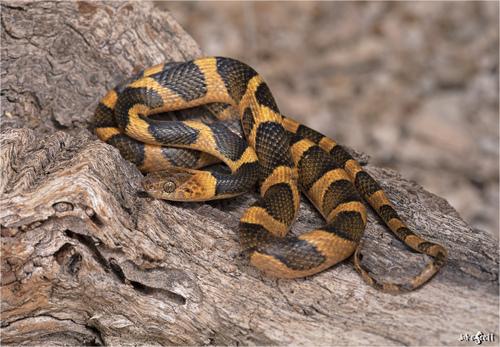
Leptodeira septentrionalis, commonly known as the northern cat-eyed snake, is a medium-sized, slightly venomous species of snake. Its range extends from southern Texas in the United States down to Costa Rica. Its full distribution includes southern Texas in the United States; the Mexican states of Chiapas, Nuevo León, Quéretaro, Oaxaca, Puebla, Coahuila, Jalisco, Campeche, Yucatán, Quintana Roo, and Nayarit; and the countries of Guatemala, Honduras, Belize, El Salvador, Nicaragua, and Costa Rica. This species occurs across elevations from 0 to 1,940 meters (0 to 6,365 feet) above sea level. Within Costa Rica, it is found on both the Caribbean and Pacific coasts, including the Golfo Dulce region, reaching up to 1,200 meters (3,900 feet) above sea level. It occupies a wide variety of habitats, but is most common at the edges of ponds where amphibians breed. The northern cat-eyed snake is oviparous, producing clutches of 6 to 13 eggs per clutch. Like many other snake species, it can experience delayed egg fertilization, meaning fertile eggs can be laid up to several years after mating. Developing embryos are nourished by a yolk sac over 79 to 90 days of development. Before hatching, hatchlings use a specialized egg tooth to break through the eggshell; this egg tooth is lost after hatching. Young northern cat-eyed snakes match the appearance of adult individuals, but their coloration is much brighter and fresher. Northern cat-eyed snakes continue growing throughout their entire lives.