About Leptinotarsa juncta (Germar, 1824)
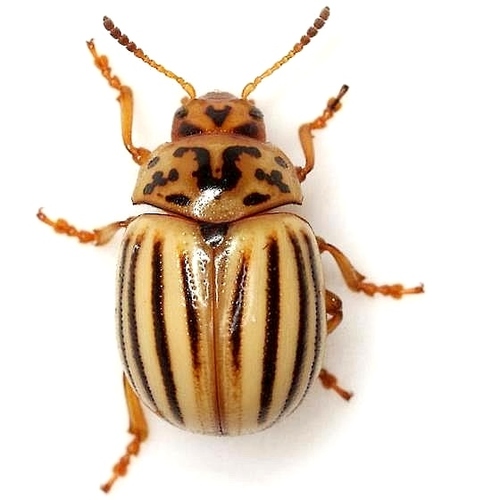
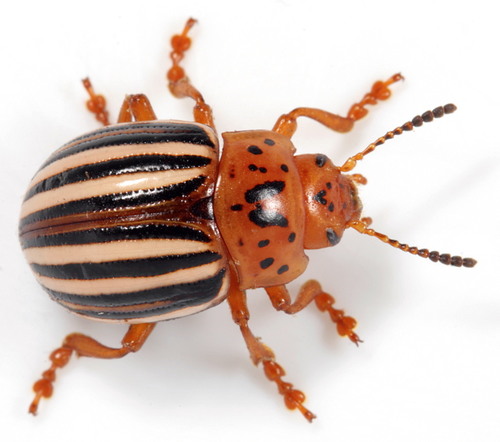
Leptinotarsa juncta, commonly known as the false potato beetle, is a species of beetle. It is found primarily in the Mid-Atlantic and Southeastern United States, and its distribution extends as far north as Maine. Adult false potato beetles emerge from the soil in late spring or early summer to begin breeding. A population of this species can complete one to three generations over a single summer. The false potato beetle feeds on solanaceous weeds, most notably horsenettle, Solanum carolinense. It also feeds on other solanaceous plants, including ground cherry or husk tomato species (Physalis spp.) and bittersweet (Solanum dulcamara). However, no growth or reproduction occurs for this species when it feeds on potato (Solanum tuberosum). False potato beetles are easily confused with their congener, the Colorado potato beetle (Leptinotarsa decemlineata). Both adult false potato beetles and adult Colorado potato beetles have alternating black and white strips on their backs. In false potato beetles, one of the white strips in the center of each wing cover is missing and replaced by a light brown strip. False potato beetle eggs are slightly larger than those of Colorado potato beetles, and fewer eggs are laid per cluster. The hump-backed larva of the false potato beetle is similar to that of the Colorado potato beetle, but it only has one row of dark spots on each side. The two species are apparently unable to crossbreed. Only the Colorado potato beetle is considered a serious pest out of these two closely related species.