About Leptinella pyrethrifolia (Hook.fil.) D.G.Lloyd & C.J.Webb
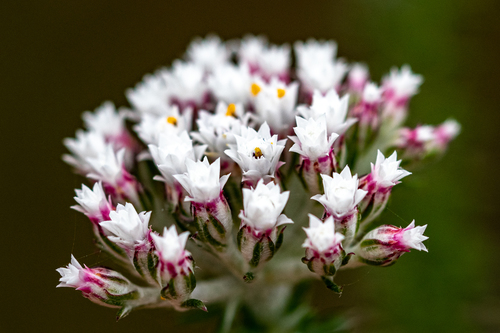
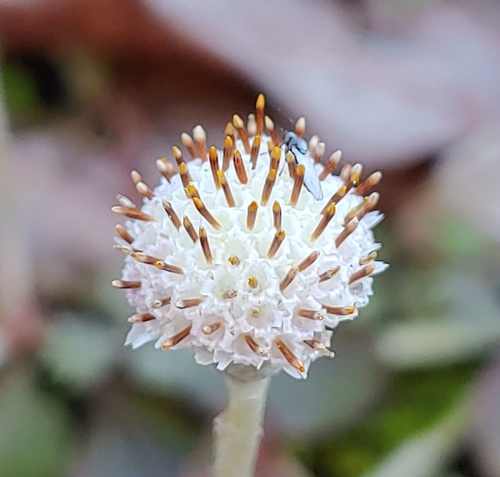
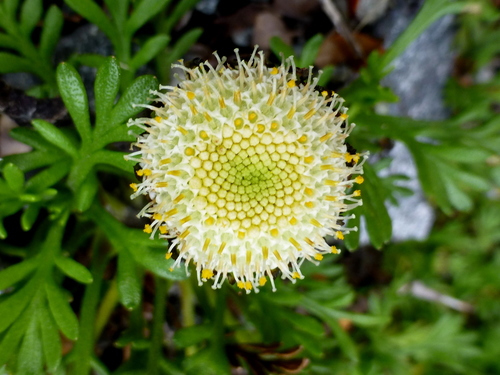
Leptinella pyrethrifolia (Hook.fil.) D.G.Lloyd & C.J.Webb has two accepted subspecies. In the nominate subspecies, this species is a perennial herb with a prostrate or creeping growth habit. Its woody rhizomes, which can be green or red, grow along the ground surface, and can form layers of living rhizomes stacked on top of older dead rhizomes. Branches grow in clusters from central nodes, and leaves can emerge a significant distance from the base of the branch. Leaves are pinnatifid, meaning they are deeply cleft into separate lobes, giving a fern-like appearance without the repeated branching of true fern leaf splits. Leaves are green, and can develop up to 40 lobes, each of which reaches a maximum length of 10 mm. The inflorescence of this species is called a capitulum, because individual florets are packed tightly enough to look like a single flower head. The species is sexually dimorphic, producing two distinct forms of capitulum: pistillate and staminate. For pistillate capitula, the surrounding involucral bracts form a hemispherical shape, while the capitulum itself is flat or convex. Florets are white, cream, or pale yellow. Staminate capitula are slightly longer overall, convex in shape, and surrounded by a flat involucre. Bisexual capitula have intermediate characteristics between the two sexual forms. The cypselae (seed-like fruits) are golden brown. The subspecies L. p. linearifolia does not have pinnatifid leaves, or very rarely develops just one or two lobes, and it can also be easily distinguished from the nominate subspecies by its restricted geographic range. Flowering occurs from November through January, during the Southern Hemisphere summer. Leptinella pyrethrifolia differs from other species in the genus Leptinella by its broad leaves, general overall structure, and white capitula. For range and habitat: the nominate subspecies occurs on both of New Zealand's main islands. On the North Island, it occurs in areas within and south of the Ruahine Range. On the South Island, it occurs from Marlborough and Nelson south to Canterbury. L. p. linearifolia is found only at Maungakura / Red Hill, a site with ultramafic and serpentine geology that supports a slightly different ecology than surrounding areas. Though the taxon is uncommon globally, it is common throughout its restricted local habitat. Both subspecies grow from montane to alpine environments, and are generally found near scree slopes, rock fields, or water sources. In terms of ecology, only the nectar of this species is used by introduced honey bees.