About Leptasthenura aegithaloides (Kittlitz, 1830)
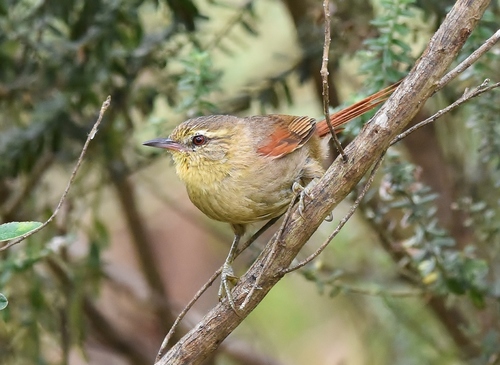
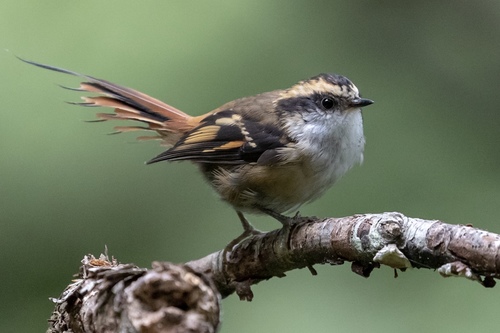
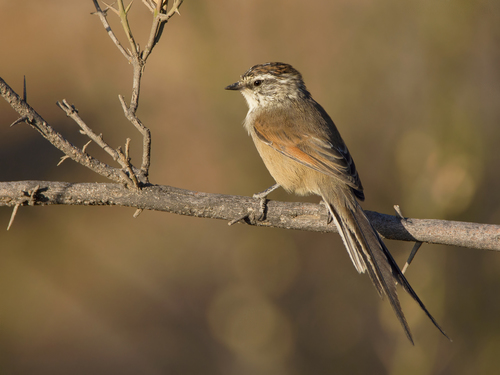
Leptasthenura aegithaloides, commonly called the plain-mantled tit-spinetail, is 15 to 17 cm (5.9 to 6.7 in) long and weighs 7.5 to 11 g (0.26 to 0.39 oz). It is a small, slender furnariid with a long tail and a short bill. The sexes share identical plumage.
Adults of the nominate subspecies L. a. aegithaloides have a white supercilium on a dark brownish face otherwise marked with whitish streaks. Their crown is dark brown with wide golden-tawny streaks; their hindneck is dark brown with grayish-white streaks, and their back, rump, and uppertail coverts are dull brownish. Their upperwing coverts are dull brownish with rufous edges, and their flight feathers are dull fuscous with dark rufous bases. Their tail feathers are dark fuscous brown with paler edges; the tail is graduated and appears forked because the central feathers have reduced inner webs. Their throat is whitish with some dark feather edges, which become more prominent on the upper breast. The remainder of the breast is dull grayish brown, and the rest of the underparts are slightly paler. Their iris is brown, their maxilla is blackish to dark gray-brown, their mandible is dark horn to greenish gray, and their legs and feet are gray to blackish. Juveniles have indistinct crown and throat markings, a lightly spotted back, and rounded tail feathers.
Subspecies L. a. grisescens is overall paler than the nominate, with wider and paler stripes on the crown, a grayer back and buffier rump, paler edges on the wing coverts, and grayer underparts. L. a. berlepschi is larger and bulkier than the nominate. It has a paler cinnamon crown with greatly contrasting streaks, pale buff streaks on the neck, cinnamon (rather than rufous) coloring on the wing coverts and flight feathers, pale buff outer tail feathers, and entirely buffy underparts. L. a. pallida has the longest tail of all subspecies. Its crown and neck are similar to those of berlepschi. Its upperparts are mostly pale gray with a pale buffy rump. It is pale cinnamon on the wing coverts and flight feathers, and its belly is pale gray, sometimes with a buff wash on the belly and flanks.
The nominate subspecies of plain-mantled tit-spinetail is found in central Chile, between the Coquimbo and Aysén regions. Subspecies L. a. grisescens, the northernmost taxon, occurs along the coast from Peru's Department of Arequipa south into northern Chile as far as the Atacama Region. L. a. berlepschi is found in the Andes of southern Peru, northern Chile, western Bolivia, and northwestern Argentina. L. a. pallida ranges from northern Argentina and southern Chile south onto Tierra del Fuego.
Different subspecies inhabit different landscapes. The nominate subspecies and L. a. grisescens occur in arid lowland and montane scrublands, open forests, and natural vegetation within human-modified areas such as agricultural fields, parks, and oases. In elevation, this group ranges from near sea level to 2,500 m (8,200 ft) in Chile, and up to 2,000 m (6,600 ft) in Peru. Subspecies L. a. berlepschi inhabits puna grasslands and scrublands of the Altiplano. In elevation, it ranges from about 3,500 to 4,300 m (11,500 to 14,100 ft) in Peru, and 2,000 to 4,200 m (6,600 to 13,800 ft) in Chile and Argentina. L. a. pallida inhabits scrublands and woodlands in the transition zone between lower elevation forest and higher steppe; it also occurs on salt flats and in arid thorny woods. In elevation, it ranges from sea level to 700 m (2,300 ft).