About Lepraria lobificans Nyl.
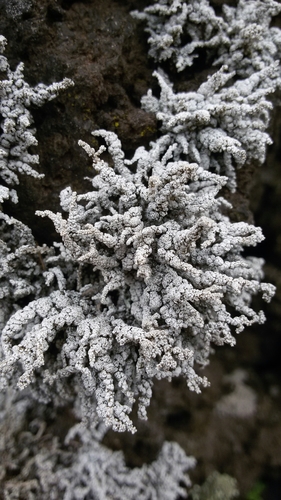
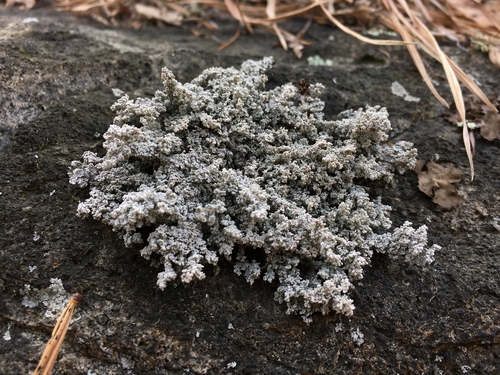
Lepraria lobificans Nyl. has a cottony thallus that is only rarely powdery, with a typically diffuse margin; weakly developed lobes are present only occasionally. A thick, white medulla is a defining characteristic of this species, while the hypothallus is seldom developed, and is pale brown when present. Unsorediate patches may expose the underlying medulla. The species produces abundant propagules: fine soredia up to approximately 60 μm across, with long, projecting hyphae. These soredia commonly form clustered consoredia that measure 100–200 μm in diameter. Chemically, Lepraria lobificans contains atranorin, the stictic acid complex, and zeorin. While Lepraria elobata shares the same major chemical compounds, it differs by having a non-lobate, leprose thallus and discrete soredia that lack projecting hyphae. Standard spot test reactions for this species are typically C–, KC–, P+ (orange), and K negative to weakly yellow. Its chemistry is dominated by atranorin alongside stictic/constictic acids, often including zeorin, and may contain traces of additional lipophilic (fat-soluble) compounds. This chemical combination matches the "L. lobificans s.str." chemotypes reported from southern Europe, which may occasionally include roccellic acid. This profile distinguishes L. lobificans from L. finkii, which is separated as a distinct species by both sequence data and chemistry (containing zeorin with minor norstictic acid). Other look-alikes with similar depsidone profiles can be differentiated by key traits: L. elobata has discrete soredia with no projecting hyphae; L. leprolomopsis has an unidentified terpenoid in place of zeorin; and L. multiacida contains additional salazinic/consalazinic acids. The name L. santosii used by some older authors refers to a lobate-margined taxon with a slightly raised rim. Lepraria lobificans grows on bark, rock (often in locations where mosses are present), and other substrates, most commonly in shaded or sheltered microsites. It has been reported from many regions worldwide; pre-molecular treatments recorded it as cosmopolitan, very common in parts of its range, and reported from all continents except Antarctica, with first national records including Jamaica and Vietnam. In South America, it has been reported from Bolivia and Uruguay, where it occurs in high-elevation Andean vegetation, mountain cloud forest, and lowlands. More recent sequence-based research shows that material previously classified as L. lobificans from the Southern Hemisphere (for example, Chile) actually belongs to L. finkii, meaning L. lobificans sensu stricto may have a more restricted distribution than previously thought. In India, the species occurs widely from the Himalayan foothills to southern hill ranges at elevations of roughly 500–3,000 m, growing on bark, rock, soil, and mossy substrates, often alongside other leprose lichens. In Central Europe, studies conducted in the Knyszyn Forest of northeast Poland found L. lobificans to be among the most frequent Lepraria species, growing mainly on the bark of deciduous trees including Carpinus betulus, Quercus robur, Fraxinus excelsior, Populus tremula, and Tilia cordata, with occasional records on Picea abies. The species is hygrophilous, meaning it is adapted for growth in damp or wet environments. It typically occurs in shaded to semi-shaded forest habitats on meso- to eutrophic, moderately acidic to basic substrates. It also colonizes rocks and mossy surfaces, and is sometimes found in more open sites near lakes and rivers, but is rarely recorded from roadside trees. Within Knyszyn Forest, it was present across multiple forest community types, and was most frequent in oak–hornbeam (Tilio-Carpinetum) stands. Additional records come from maple–linden slope forest, alder carr, riparian alder forest, pine forest (Peucedano-Pinetum), and bog–spruce forest (Sphagno girgensohnii-Piceetum).