About Lepiota cristata (Bolton) P.Kumm.
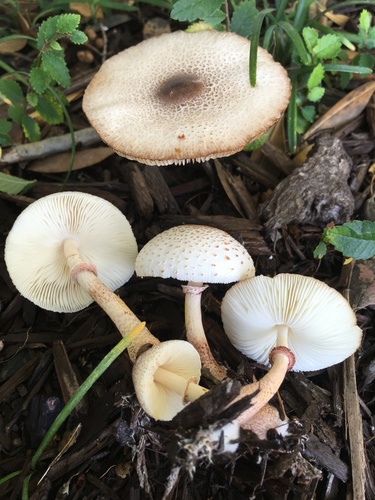
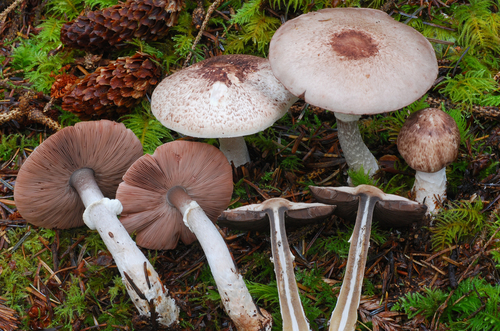
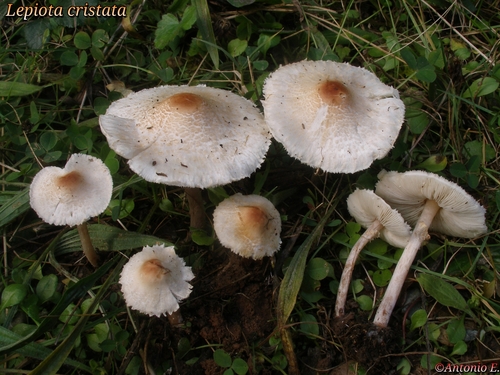
Lepiota cristata (Bolton) P.Kumm. produces fruit bodies with caps that have a white to cream base color, covered in concentrically arranged reddish-brown scales. Mature caps measure 1–5 cm (0.4–2.0 in) across, with a darker reddish-brown center. Caps start out bell-shaped to convex, then flatten at maturity and develop an umbo. The crowded gills are white to cream, do not attach to the stipe, and turn brownish as the mushroom ages and spores mature. The stipe is 2–6 cm (0.8–2.4 in) long and 0.2–0.7 cm (0.1–0.3 in) thick. It is nearly smooth, has pale white-tinged flesh, and bears a transient, membranous, deciduous ring. The mushroom’s flesh is thin and white. The spores of Lepiota cristata have a dorsal spur that gives them a triangular or wedge shape, and they measure 7–8.5 by 3–4 μm. They are slightly dextrinoid, meaning they stain deep red to reddish brown when treated with Melzer's reagent. Cheilocystidia (cystidia on the gill edge) are club-shaped, measuring around 15–25 by 8–14 μm. No pleurocystidia (cystidia on the gill face) are present, and the pileipellis is a hymeniform layer of hyphal cells measuring about 30–50 by 10–25 μm. The spore print left by fallen spores is white, except for the variety L. cristata var. viridispora, which produces a greyish-green spore print similar to that of the false parasol (Chlorophyllum molybdites). This species has a strong, distinctive, unpleasant odor, which has been variously described as rubbery, fishy, pungent, foul, fungusy, fruity, mealy, or sweet. Despite this, it has a mild and pleasant taste. Lepiota cristata is a saprobic species that gets nutrients by breaking down dead or decayed organic material. It has been observed growing saprobically on soil under broadleaved and conifer (Pinopsida) trees. It grows either singly or in small groups, across a wide range of habitats including woodlands, shady damp gardens, garden waste areas, short grass, leaf litter, paths, ditches, and other disturbed ground. It is one of the most widely distributed Lepiota species, found in North America north of Mexico, across Europe, northern Asia, and New Zealand. It is not confirmed whether Lepiota cristata is poisonous to humans, but mycologists consider it suspect, because many other small Lepiota species are poisonous. There are reports that this species causes gastrointestinal symptoms. Until recently, toxicity confusion caused avoidable harm: in Great Britain, dapperlings were commonly called parasols, while true edible parasol mushrooms belong to the genus Macrolepiota (often specifically Macrolepiota procera). This frequent misidentification likely increased the number of poisoning incidents.