About Lepiota clypeolaria (Bull.) P.Kumm.
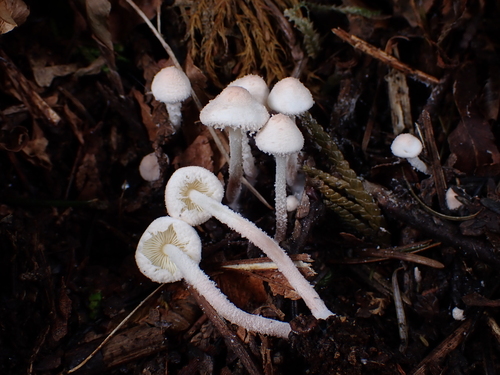
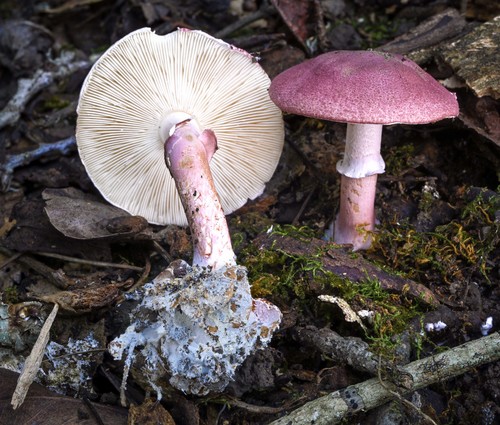
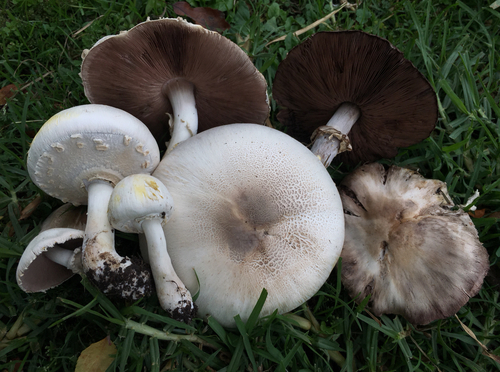
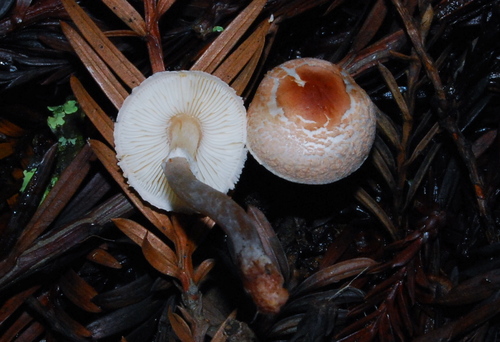
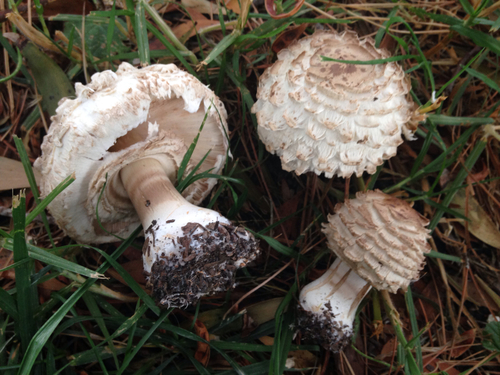
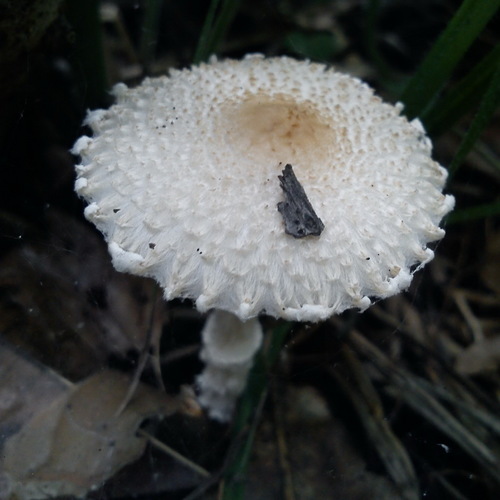
The scientific name of this species is Lepiota clypeolaria (Bull.) P.Kumm. When young, its cap is egg-shaped, and it quickly becomes broadly bell-shaped. The cap has pale straw-colored or orange-brown scales over a pale background. Its central umbo is covered by a clearly bounded, uniform disk that matches the color of the scales. The cap grows to a diameter of 4–7 cm (1.6–2.8 in). The gills are white, crowded, and do not attach to the stipe. The stem is white and bears an indistinct ring. Below the ring, the stem surface is coarsely woolly, an appearance that is sometimes described as "booted". The stipe is 5–12 cm (2.0–4.7 in) long, 0.3–1 cm (0.12–0.39 in) thick, hollow and slender, and expands slightly into a club shape at the base. The flesh is white and has an unpleasant odor. The spore print is white. The spores are fusiform (fuse-shaped), meaning they are tapered at both ends. They measure 12–16 by 5–6 μm. Cheilocystidia (cystidia found on the gill edge) are club-shaped to cylindrical, and measure 20–40 by 5–15 μm. Fruit bodies grow singly or in small groups on the ground in both deciduous and coniferous forests. It is a common species, widespread across temperate regions of the Northern Hemisphere, and has been recorded in Asia, Europe, North America, and South America. Fruiting takes place in autumn. In China, it has been recorded from the provinces of Heilongjiang, Jilin, Liaoning, Jiangsu, Guangdong, and Yunnan. Lepiota clypeolaria is classified as poisonous, and it is particularly notable for its similarity to several more deadly species in the same genus.