About Lepiota castaneidisca Murrill
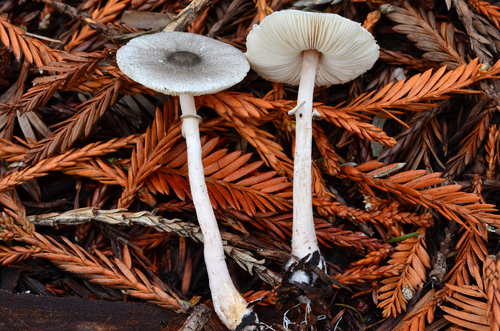
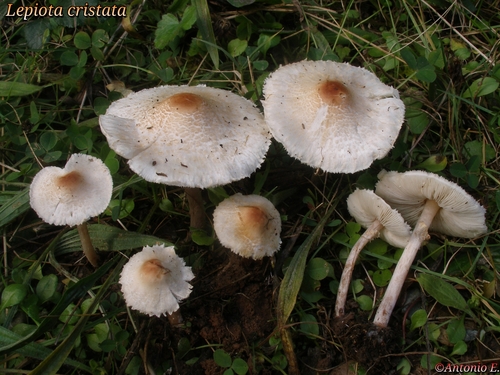
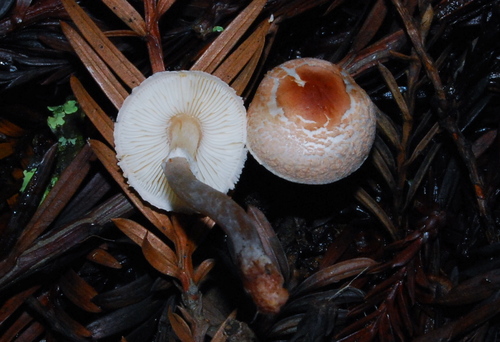
Lepiota castaneidisca Murrill produces fruit bodies with white, bell-shaped to convex caps 0.8 to 3.2 cm (0.3 to 1.3 in) in diameter, with an orange-reddish to pale orange-brown center. Mature specimens fade and lose their reddish shades. On a white background of radially arranged fibrils, the cap surface develops small pale pink or cream patches, especially on the outermost zone of the cap. The gills range from somewhat crowded to moderately distant, with typically 40–45 full-length gills, and 1–5 tiers of interspersed lamellulae, which are short gills that do not extend fully from the cap margin to the stem. The gills are slightly ventricose, 2.5–5 mm wide, and have a white fringed or irregular edge. They are whitish when young and turn cream-colored as they age, and have a free attachment to the stem. The stem is 25–65 mm (1.0–2.6 in) long by 2–6 mm (0.1–0.2 in) thick. It is cylindrical, slightly widened at the base, hollow, and fibrillose. The lower part of the stem is pinkish, and it stains reddish when damaged, especially in older specimens. The flesh is whitish, sometimes with cream tones, or reddish-brown in mature specimens. A ring pointing upward is present on the stem in young specimens; in maturity, it degrades into remnants that remain on the stem. This mushroom has a sharp odor similar to rubber or cod liver oil. It is not known to be poisonous, but consumption is not recommended because it can be confused with deadly amatoxin-containing Lepiota species. The smooth, dextrinoid spores of Lepiota castaneidisca are triangular with a spurred base when viewed from the side, and oblong when viewed from the front. They typically measure 5–9 by 3–4 μm. Staining with Cresyl blue shows spores to be somewhat metachromatic and binucleate. Cheilocystidia (cystidia on the gill edge) are club-shaped to cylindric, or sometimes spheropedunculate (somewhat spherical with a stalk), and measure 20–44 by 6.5–13.5 μm. Basidia are 18–30 by 5–8 μm, mostly four-spored, and are absent from the gill edge. Pleurocystidia (cystidia on the gill face) are absent. The cap cuticle is a hymeniderm made of lengthened cells arranged side by side, with mostly colorless elements of varying lengths that measure 16–62 by 8–18 μm. The stipitipellis, the outer covering of the stem, is formed by a layer of colorless hyphae about 2–3 μm wide. Clamp connections are present in the hyphae of all parts of the fungus. Lepiota castaneidisca is a saprobic fungus. Its fruit bodies appear in late fall and winter, from November to February, growing gregariously near cypress or redwood, or in mixed coast live oak forests. The fungus is common in coastal and northern California, and is often found in the San Francisco Bay Area. Its distribution extends north to Washington state and southern British Columbia, and has been recorded as far south as Mexico.