About Lepiota brunneoincarnata Chodat & C.Martín
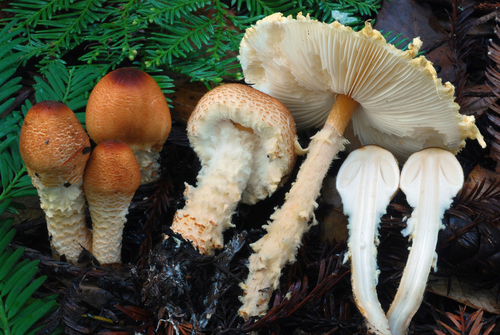
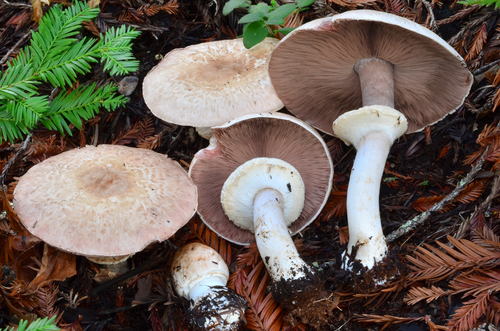
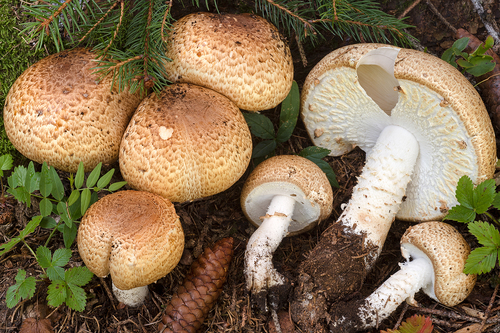
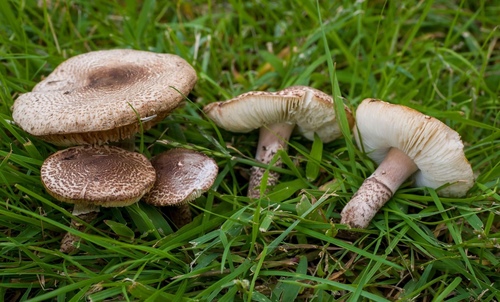
The cap of Lepiota brunneoincarnata, commonly known as the deadly dapperling, measures 2.7–4 cm (1.1–1.6 in) across. It is hemispherical when young, later becoming more convex without a distinct raised boss. Young caps are red-brown, fading to pale pinkish brown at maturity, and covered with darker brown scales. There is typically a large, unbroken patch of darker scale covering the center of the cap. The cap margin is inrolled, and the cap flesh is thick. The gills are thick, uncrowded, and white, with occasional forking and smaller partial gills (lamellulae) between the full gills. They are free, meaning they do not attach to the stem. The spore print of this species is white. The stem is cylindrical, growing 2–3.5 cm (0.8–1.4 in) tall and 0.6–0.9 cm (0.2–0.4 in) wide. The upper section of the stem is pinkish tan, while the lower section is covered in dark brown scales. A dark brown ring-like zone separates these two colored regions of the stem. The thick flesh of the mushroom reddens when bruised or cut, has a scent similar to unripe fruit, and a mild taste. The spores are oval, measuring 6–7.5 μm long by 3.5–5 μm wide, and are dextrinoid, meaning they turn red-brown when tested with Melzer's reagent. The deadly dapperling occurs in warmer, generally southern regions of Europe, and has also been recorded in Britain and Germany. In Asia, it has been documented in Turkey, Israel, Pakistan, Iran, and eastern China. This species contains deadly levels of the toxin alpha-amanitin. It has caused a fatal poisoning in Spain in 2002, a poisoning outbreak in Iran in 2018, and the deaths of four young family members in Tunisia in 2010. One person survived after eating five specimens that were picked alongside Agaricus bisporus in Kaynarca, Sakarya, Turkey, in 2013. Initial poisoning symptoms are gastrointestinal, with nausea and vomiting starting around ten hours after consumption, followed by liver damage a few days later. Consumption of 100 g of Lepiota brunneoincarnata can cause severe liver damage. Deadly dapperlings often grow in grassy areas, which leads to accidental foraging mistakes. They resemble the edible fairy ring champignon Marasmius oreades, though the pale brown cap of Marasmius oreades does not have scales, unlike the deadly dapperling. They also grow commonly in garden grassy areas, leading to misidentification by home foragers. One family in Salon-de-Provence, France, was poisoned after mistaking deadly dapperlings for the edible grey knight Tricholoma terreum. After ingestion, amanitin can be detected in urine between 36 and 48 hours. If the mushroom is not correctly identified, the initial acute gastric symptoms can mislead medical treatment and delay targeted liver-protective interventions. Intravenous silibinin helps reduce uptake of amanitin by the body. Other targeted treatments include penicillin G and n-acetylcysteine, alongside general supportive measures such as rehydration. Liver transplantation may be necessary if these interventions are not successful.