About Lepidospartum squamatum (A.Gray) A.Gray
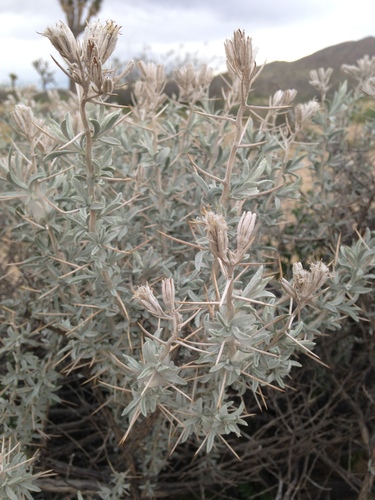
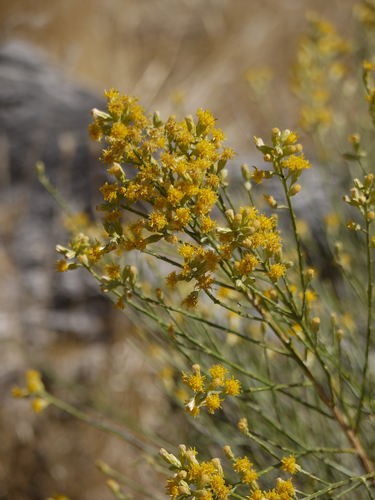
Lepidospartum squamatum, also called scale broom, is a large spreading, rounded shrub that often grows taller than two meters. Its branches are covered in woolly fibers, and it bears stubby leaves no longer than 3 millimeters. These drought-adapted traits allow it to flower during hot summers, when most other plants are dormant, making it an important resource for pollinators. The inflorescence grows at branch ends, and consists of either a single flower head or a small cluster of up to 5 heads. The flower heads are discoid, with many yellow tubular disc florets and no ray florets. Its fruit is a narrow achene a few millimeters long, topped with a dull white to light brown pappus. While blooming, scale broom attracts a wide variety of pollinators, including bees, butterflies, moths, and tarantula hawk wasps. As fruits mature and flower parts fall off, the accumulation of pappi gives the inflorescence a cottony appearance. Lepidospartum squamatum is native to the mountains, valleys, and deserts of central and southern California, and Baja California. It grows in sandy, gravelly soils across several habitat types, and is especially common in dry alluvial habitats such as arroyos. It is recognized as an indicator species for the alluvial scrub habitat type in this region, and it is also commonly found in neighboring Arizona.