About Lepidocolaptes souleyetii (Des Murs, 1849)
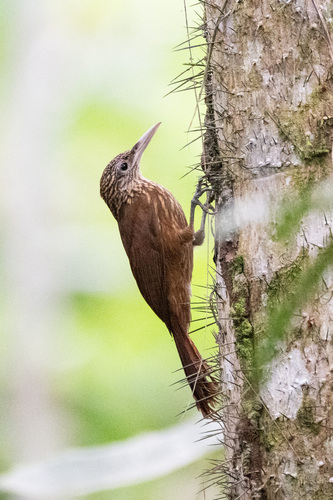
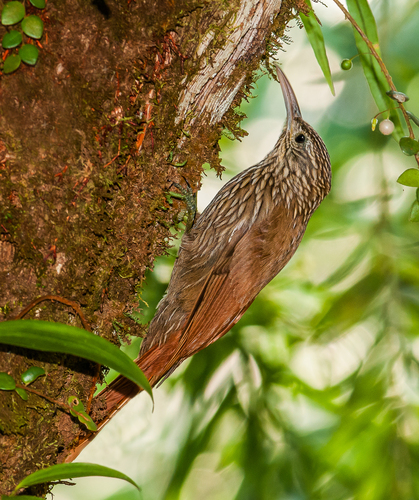
The streak-headed woodcreeper (scientific name Lepidocolaptes souleyetii (Des Murs, 1849)) measures 19 to 21 cm (7.5 to 8.3 in) in length and weighs 23 to 31 g (0.81 to 1.1 oz). It is a slim, medium-sized woodcreeper with a moderately long, slender, decurved bill. Males and females have identical plumage. Adults of the nominate subspecies L. s. souleyetii have faces patterned with thin whitish buff and dark brown streaks, and the sides of the neck have heavier streaking. They have a whitish buff supercilium and eyering. Their crown and nape are dark brown, marked with bold whitish buff streaks that often extend onto the upper back. Their back and wing coverts are rufous-olive to cinnamon-brown, while their flight feathers, rump, and tail are cinnamon-rufous to rufous-chestnut. The primaries have brownish edges and dusky tips. Their throat is whitish buff to pale cinnamon. Their underparts are grayish olive to buffy brown, with black-edged whitish buff streaks; these streaks are wide on the breast and sides, narrower on the belly and flanks, and minimal on the undertail coverts. Their underwing coverts are ochraceous to pale cinnamon-buff. Their iris is pale brown or brown, their bill is pale brown or horn-colored with most of the mandible bluish-pink, and their legs and feet are grayish olive-green. Juveniles are very similar to adults, but have small scattered dusky spots instead of streaks on their underparts.
Other subspecies of the streak-headed woodcreeper differ from the nominate and each other as follows: L. s. lineaticeps has narrower streaks on the crown and underparts than the nominate, darker rufous coloration on the rump, wings, and tail, and a dark brownish maxilla. L. s. littoralis resembles lineaticeps but is smaller, paler, less rufescent on the upperparts, and more buffy on the underparts. L. s. uaireni resembles lineaticeps but is darker overall, has more whitish (less buffy) streaks, and blacker edges on underparts streaks. L. s. compressus resembles lineaticeps but is darker with wider streaks on both upperparts and underparts, and has a pale buff to whitish throat. L. s. guerrerensis is slightly larger, has paler red upperparts, and grayer underparts than compressus. L. s. esmeraldae has deeper buff throat and underparts streaks than the nominate, and a shorter bill.
Subspecies of the streak-headed woodcreeper have the following distribution: L. s. guerrerensis is found in Mexico's Sierra Madre del Sur in Guerrero and Oaxaca. L. s. compressus ranges from Veracruz, Campeche, and Chiapas in southern Mexico through Central America into western Panama. L. s. lineaticeps ranges from Panama's Canal Zone into northern and eastern Colombia and western Venezuela. L. s. littoralis occurs in Trinidad, northeastern Colombia's Atlántico Department and Santa Marta region, central Venezuela, Guyana, and extreme northern Brazil. L. s. uaireni is found in southeastern Venezuela's Bolívar state. L. s. esmeraldae ranges from southwestern Colombia's Nariño Department south through Ecuador into El Oro Province. L. s. souleyetii ranges from southwestern Ecuador's El Oro and Loja provinces into northwestern Peru as far as the Department of Lambayeque.
The streak-headed woodcreeper inhabits a variety of mostly semi-open to open wooded landscapes. These include deciduous and moderately humid forest, gallery forest, secondary forest, plantations, the edges of humid forest, and open areas with scattered trees. It also occurs locally in mangrove and arid scrublands. In terms of elevation, it reaches 1,500 m (4,900 ft) in Mexico, 1,850 m (6,100 ft) in northern Central America, and 1,500 m (4,900 ft) in Costa Rica (where it is uncommon above 900 m (3,000 ft)). It reaches 1,500 m (4,900 ft) in Colombia, and 1,600 m (5,200 ft) in Venezuela. In Ecuador it mostly occurs below 800 m (2,600 ft) but locally reaches 1,800 m (5,900 ft) in Loja Province.