About Lepidocolaptes leucogaster (Swainson, 1827)
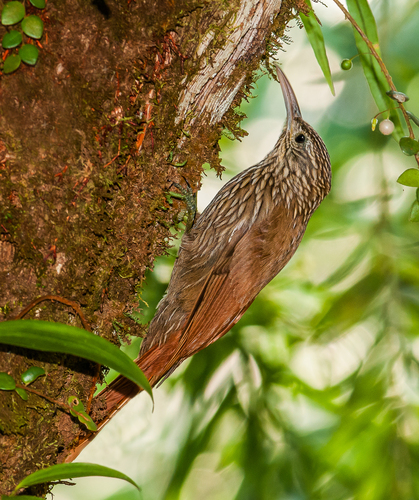
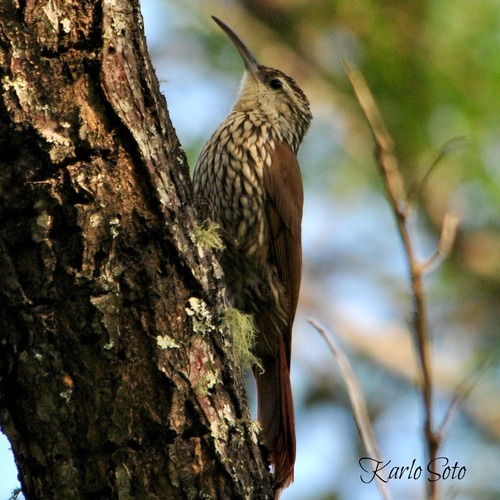
The white-striped woodcreeper (scientific name Lepidocolaptes leucogaster, first described by Swainson in 1827) measures 21.5 to 23.5 cm (8.5 to 9.3 in) in length and weighs 30 to 40 g (1.1 to 1.4 oz). It is a slim, medium-sized woodcreeper with a long, slender, decurved bill. The sexes of this species have identical plumage. Adults of the nominate subspecies have a mostly pale face, which often has dusky streaks or smudges. They have white to buff-white ear coverts, supercilium, and eyering, with a blackish or dusky stripe running behind the eye. Their crown, nape, and sides of the neck are blackish to dark brown. Their forehead has buffy to whitish buff spots that extend into streaks on the crown and nape, and usually continue onto the back. Their back and wing coverts are olive-brown or tawny. Their flight feathers, rump, and tail are cinnamon-rufous to rufous-chestnut. Their flight feathers have brownish bases, and their primaries have dusky tips. Their throat and breast are white to creamy white; the throat has no markings, and the breast has a blackish scaly appearance. The rest of their underparts are dusky gray with white streaks that fade toward the belly. Their underwing coverts are ochraceous buff. Their iris is brown, their maxilla is dark brown or blackish, their mandible is whitish gray to pinkish, and their legs and feet are gray to blackish. Juveniles have more olive-brown upperparts than adults, their underpart markings are less regular, and their bill is shorter. The subspecies L. l. umbrosus is smaller than the nominate subspecies, with whiter spots and streaks on the head, and whiter underparts with blacker streaks. The white-striped woodcreeper is found only in Mexico. Subspecies L. l. umbrosus occurs in northwestern Mexico, ranging from Sonora and Chihuahua south to Durango, Nayarit, and Jalisco. The nominate subspecies L. l. leucogaster is found in western and southern Mexico. On the Pacific side and interior, it occurs from Jalisco and Zacatecas south to Oaxaca, and on the Caribbean side it ranges from Veracruz south to Oaxaca. This species mostly lives in humid montane forest and drier oak, pine-oak, and pine-fir forest in the subtropical and temperate zones. It also occurs in lowland tropical deciduous forest, and at higher elevations, in mixed coniferous forest. It prefers mature forest, but is occasionally found in secondary forest. Most of its population occurs at elevations between 900 and 3,500 m (3,000 to 11,500 ft), though it has been recorded as low as 400 m (1,300 ft) and as high as 4,000 m (13,000 ft).