About Lepidocolaptes lacrymiger (Des Murs, 1849)
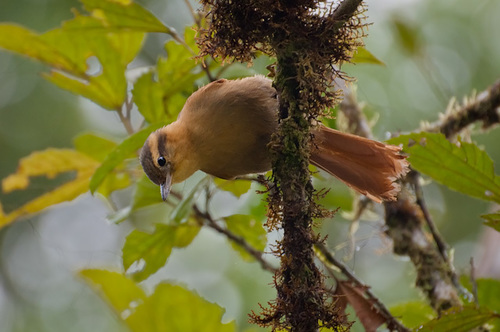
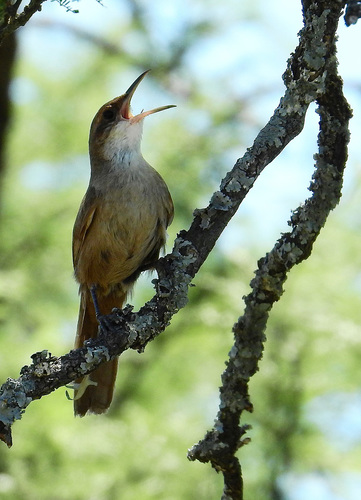
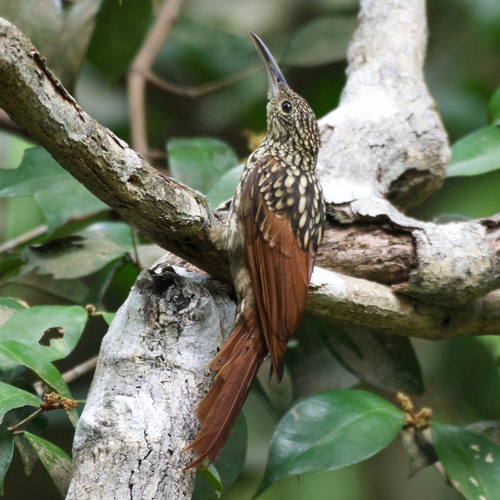
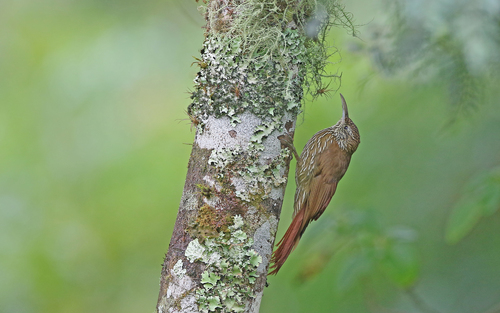
Montane woodcreeper (Lepidocolaptes lacrymiger, originally described by Des Murs in 1849) measures 19 to 19.5 cm (7.5 to 7.7 in) in length. Males weigh 31 to 35 g (1.1 to 1.2 oz), while females weigh 29.5 to 33 g (1.0 to 1.2 oz). It is a smallish to medium-sized woodcreeper with a slim, slightly decurved bill. The two sexes have identical plumage. Adults of the nominate subspecies L. l. lacrymiger have noticeably streaked faces and necks, with an often broken whitish supercilium. Their crown and nape are dusky brown, marked with distinct whitish buff spots that have black tips; these spots transition into streaks along the nape. Their back and wing coverts are rufous-brown, and their rump, wings, and tail are rufous-chestnut. Their underparts are olive-brown, with long, wide buffy streaks that have black edges and black tips. They have dark brown irises, and their legs and feet range from olive-gray to dark horn. Their upper mandible is blackish to dusky gray or dark horn, while their lower mandible is pale gray to whitish. Juveniles have less distinct borders on their underpart streaks, and a shorter, darker bill. Other subspecies differ from the nominate subspecies and each other in the following ways: L. l. sanctaemartae has a paler throat with dimmer markings than the nominate, and grayer underparts with wider, whiter streaks that have black edges but no black tips; L. l. sneiderni is darker than the nominate, more olive-gray overall, and has fewer, smaller, and shorter underpart streaks; L. l. lafresnayi is more olive-brown overall than the nominate, with paler underparts and no rufescent tones; L. l. warscewiczi is darker and more rufescent overall than the nominate, has streaks on its back, and has deeper buff underpart streaks that have black edges but no black tips; L. l. aequatorialis is similar to L. l. warscewiczi, but has slightly more rufescent underparts, a buffier throat, and wider underpart streaks; L. l. frigidus is similar to L. l. aequatorialis, but has more olivaceous upperparts and a darker bill; L. l. carabayae is similar to L. l. warscewiczi, but is slightly darker overall, has more olive underparts with narrower streaks, and has a shorter, more curved bill with a whitish maxilla; L. l. bolivianus, compared to L. l. carabayae, has a buffier throat, paler and less rufescent upperparts, and more olivaceous underparts with wider whiter streaks. Subspecies of montane woodcreeper have the following distribution ranges: L. l. sanctaemartae occurs in the Santa Marta region of northern Colombia; L. l. sneiderni occurs in the Western and Central Andes of Colombia, the western slope of the Eastern Andes of Colombia, and the river valleys between these ranges; L. l. lacrymiger occurs on the eastern slope of Colombia's Eastern Andes, and in Cordillera de Mérida and Serranía del Perijá in western Venezuela; L. l. lafresnayi occurs in the Venezuelan Coastal Range; L. l. aequatorialis occurs on the western slope of the Andes in southwestern Colombia's Nariño Department, extending south along both slopes of the Andes in Ecuador to Loja Province on the western slope, and extending a shorter distance south on the eastern slope; L. l. frigidus occurs on the eastern slope of the Andes in Nariño Department, Colombia; L. l. warscewiczi occurs on the eastern slope of the Andes in extreme southeastern Ecuador, extending south into Peru as far as the Department of Junín; L. l. carabayae occurs on the eastern slope of the Andes in the southeastern Peruvian departments of Cuzco and Puno; L. l. bolivianus occurs on the eastern slope of the Andes in northwestern and central Bolivia. The montane woodcreeper population on the western slope of the Andes in northwestern Peru may belong to either L. l. aequatorialis or L. l. warscewiczi. The montane woodcreeper inhabits a variety of forested landscapes, mostly at mid- to upper elevations. It favors montane evergreen forest and cloudforest, and also occurs in somewhat open woodland, montane deciduous forest, and stunted forest near treeline. It is found in the interior of primary forest, but is thought to be more common at forest edges and in mature secondary forest. It also occurs in clearings and pastures that retain scattered trees. Its general elevation range is between 1,750 and 3,000 m (5,700 and 9,800 ft), though it is occasionally found as low as 900 m (3,000 ft) in Venezuela. In Colombia it ranges between 1,700 and 3,500 m (5,600 and 11,500 ft), and in Ecuador it ranges between 1,500 and 3,000 m (4,900 and 9,800 ft).