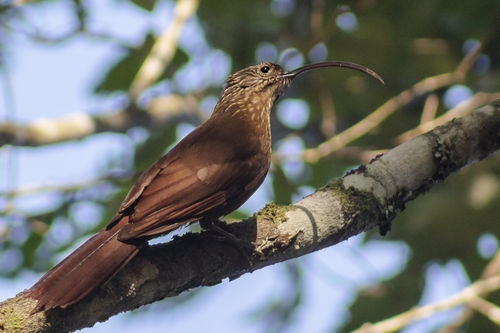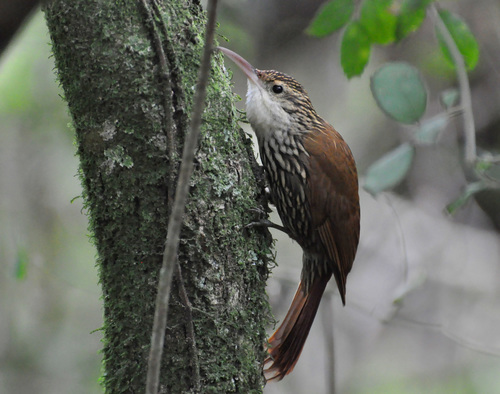
About Lepidocolaptes falcinellus (Cabanis & Heine, 1859)
The scalloped woodcreeper (Lepidocolaptes falcinellus) measures 17 to 20 cm (6.7 to 7.9 in) in length and weighs 26 to 30 g (0.92 to 1.1 oz). It is a medium-sized woodcreeper with a moderately long, slightly curved bill. The two sexes have identical plumage. Adult scalloped woodcreepers have creamy white faces marked with blackish mottling, along with creamy white lores and supercilium. Their crown and nape are dusky to dull black, with distinct rich buff spots that often fade into faint streaks extending onto the upper back. Their back and wing coverts are colored olive-brown to cinnamon-brown, while their rump and tail are rufous-chestnut. Their flight feathers have brown outer webs, chestnut inner webs, and blackish brown tips. Their throat is whitish. Their underparts are olive-colored, marked with bold buff streaks bordered with blackish that create a scaly appearance. Their underwing coverts are cinnamon. Their iris is brown, and their legs and feet range from greenish gray to greenish brown. The maxilla of the bill is gray, light brown, or pinkish, often with a darker base, and the mandible is creamy white to light brown. The scalloped woodcreeper's distribution extends from northeastern São Paulo state in southern Brazil southward to Alto Paraná Department in southeastern Paraguay, Misiones and Corrientes provinces in northeastern Argentina, and extreme northeastern Uruguay. It inhabits humid Atlantic Forest and drier forest in the planalto. In the northern portion of its range it occurs in montane evergreen forest and rainforest, further south it is found in Araucaria forest, and it occurs only infrequently in semi-deciduous forest in the southwest. It can be found both at the edges and in the interior of primary forest and mature secondary forest. In terms of elevation, it mostly occurs from lowlands up to 1,600 m (5,200 ft), and is only rarely found as high as 2,000 m (6,600 ft).