About Lepidochelys kempii Garman, 1880
Taxonomic Identification
Kemp's ridley (Lepidochelys kempii Garman, 1880) is the smallest sea turtle species.
Size Characteristics
Mature individuals have a carapace length of 58–70 cm (23–28 in) and weigh 36–45 kg (80–100 lb), while adults reach a maximum carapace length of 75 cm (30 in) and a maximum weight of 50 kg (110 lb).
General Body Structure
Like other sea turtles, it has a dorsoventrally flattened body, specially adapted flipper-like front limbs, and a beak.
Carapace Characteristics
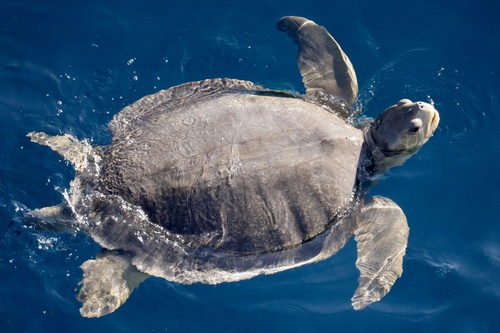
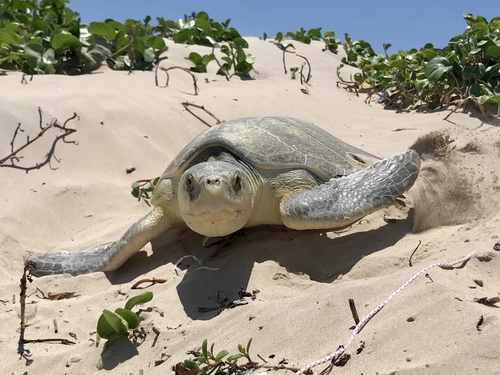
The adult's oval carapace is almost as wide as it is long, and is typically olive-gray. It has five pairs of costal scutes.
Scute and Scale Features
Four inframarginal scutes, each perforated by a pore, sit in each bridge that connects the plastron to the carapace, and the head has two pairs of prefrontal scales.
Ontogenetic Coloration
This species changes color as it matures: hatchlings are almost entirely dark purple on both upper and lower surfaces, while mature adults have a yellow-green or white plastron and a grey-green carapace.
Head and Beak Structure
Kemp's ridley has a triangular head with a somewhat hooked beak that features large crushing surfaces. Its skull is similar to that of the olive ridley.
Skull Morphology
Unlike other sea turtles, the surface of the squamosal bone where jaw opening muscles originate faces sideways instead of toward the back.
Nesting Behavior
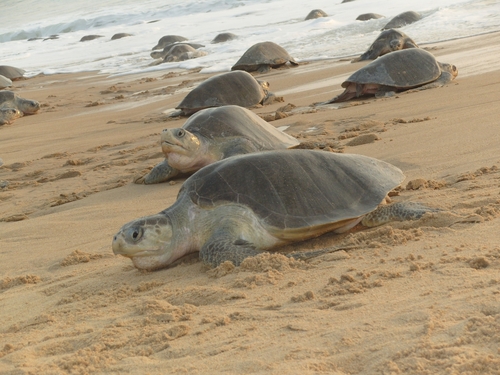
Kemp's ridley is the only sea turtle that nests during the day.
Distribution Variability
The distribution of Lepidochelys kempii is unusual compared to most reptiles, and varies significantly between adults and juveniles, as well as between males and females.
Adult Habitat
Adults primarily live in the Gulf of Mexico, where they forage in the relatively shallow waters of the continental shelf. These waters can reach 409 m deep, but are typically 50 m deep or less.
Sex-Specific Adult Range
Females range from the southern coast of the Florida Peninsula to the northern coast of the Yucatán Peninsula, while males tend to stay closer to nesting beaches in the Western Gulf waters of Texas (USA), Tamaulipas, and Veracruz (Mexico).
Adult Atlantic Occurrence
Adults of L. kempii are rarely found outside the Gulf of Mexico, and only 2–4% of L. kempii found in the Atlantic are adults.
Juvenile Migration Range
In contrast, juveniles and subadults regularly migrate into the Atlantic Ocean, and occupy the coastal waters of the North American continental shelf from southern Florida to Cape Cod, Massachusetts, and occasionally further north.
Migration Climate Impact
Migration time periods are growing longer due to rising sea temperatures.
Vagrant Dispersal Mechanism
Accidental and vagrant occurrences are regularly recorded across the northern Atlantic Ocean and Mediterranean Sea, and the Gulf Stream is thought to play a major role in their dispersal.
Confirmed Vagrant Localities
Confirmed records exist from Newfoundland to Venezuela in the west, and from Ireland, the Netherlands, and Malta in the Mediterranean in the east, with many confirmed localities in between. More than 95% of these extra-range records involve juveniles or subadults.
Unverified African Records
Several reports from the African coast between Morocco and Cameroon involve unverified specimens, and may include misidentified Lepidochelys olivacea.
2021 Wales Stranding
In November 2021, a live male Kemp's ridley was found on Talacre beach in North Wales. The turtle was taken to Anglesey Sea Zoo for treatment, with plans to eventually transport it back to the Gulf of Mexico.