About Lepidium draba L.
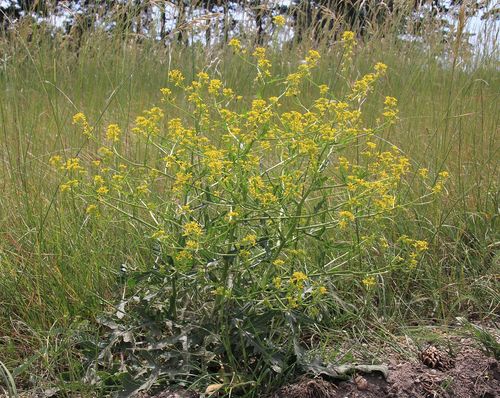
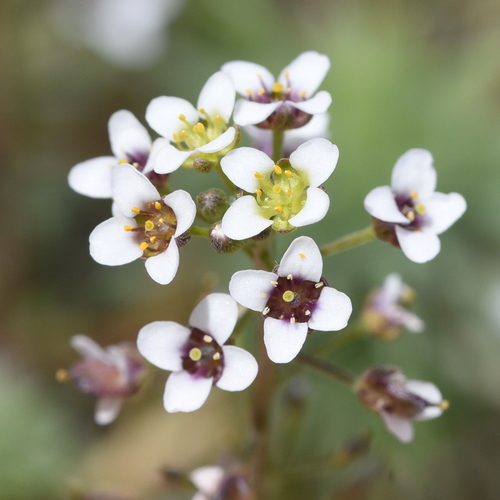
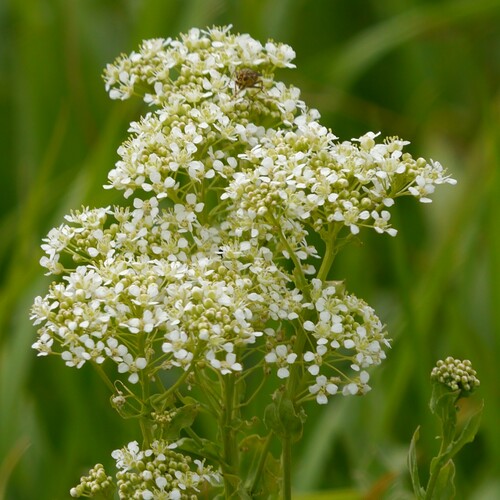
Lepidium draba L., also known as whitetop or hoary cress (and previously classified as Cardaria draba), is a perennial herb that reproduces both by seeds and by horizontal creeping roots. Its stems are somewhat stout, and grow either erect or spreading, reaching 10 to 80 cm in height. Stems are branched, and covered in a sparse to heavy layer of ash-colored soft hairs. Leaves grow alternately along stems, are simple, and are mostly toothed along their edges. Basal leaves measure 4 to 10 cm in length, have a short petiole (leaf stem), and are long and flat, shaped like a lance or an egg, with the narrow end connected to the stalk. Upper stem leaves attach directly to the stalk (a condition called sessile), measure 2 to 6.5 cm long, are oblong or taper to a pointed tip, and have broad bases that clasp around the stem. Whitetop produces slightly domed flower clusters that are corymb-like, meaning individual flower stalks grow upward from different points on the branch to reach roughly the same height. Each flower has petals that are white and clawed, 3 to 5 mm long, approximately twice the length of the flower’s sepals. Most flowers have four petals.
This species is native to western Asia and southeastern Europe. It was introduced to North America in contaminated seeds in the early 1900s, and is now an invasive species there. It also grows as a weed across much of southeastern and southwestern Australia. Researchers have suggested that native grasses from the Poa genus may be able to outcompete hoary cress in North America. Traditionally, hoary cress has been used for medicinal purposes, including anti-inflammatory and antibacterial treatments.