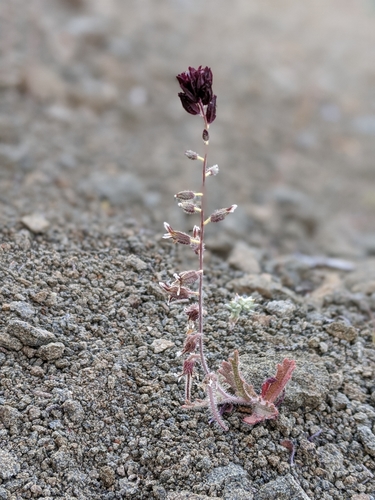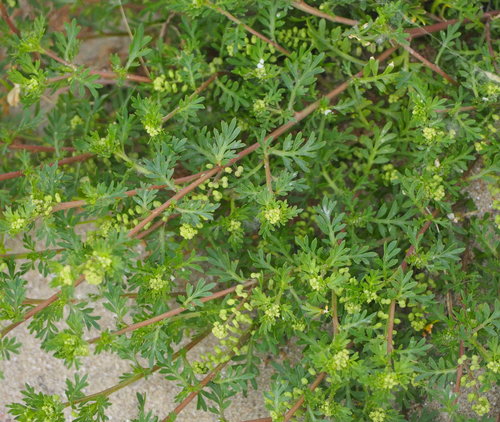
About Lepidium didymum L.
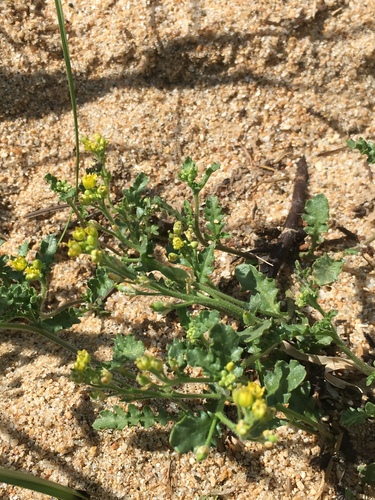
Lepidium didymum L. is an annual or biennial glabrous herb. Its green decumbent or ascending stems grow up to 40 centimetres (16 in) long, radiating out from a central base. Its alternate pinnate leaves can reach 5 cm (2 in) in length. It blooms between July and September. Its flowers are inconspicuous, with four very short white petals or no petals at all, and usually 2 stamens, rarely 4. Its fruits form from two rounded valves that are notched at the apex, with a very short style positioned between the valves. The fruits are wrinkled, and contain orange or reddish brown seeds that measure 1–1.5 mm long.
The origin of Lepidium didymum is uncertain, but it is often reported to be native to South America, specifically Argentina, Bolivia, Brazil, Chile, Paraguay, Peru, Uruguay, and Venezuela. It has been introduced to other regions worldwide as a cultivation weed, and has become naturalized across Africa, Europe, Asia, Australasia, North America, and additional parts of South America. In Britain, it was first recorded in the wild by 1778, and grows primarily in England and southern Ireland. It can be found growing on cultivated ground, waste ground, in gardens and lawns, and alongside paths and roadsides.
The leaves of Lepidium didymum are edible, and have a salty flavour similar to cress or mustard.