About Lepechinia fragrans (Greene) Epling
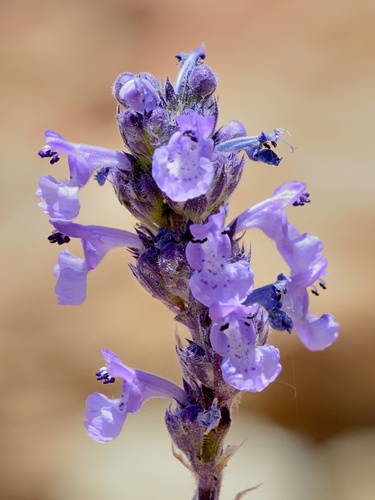
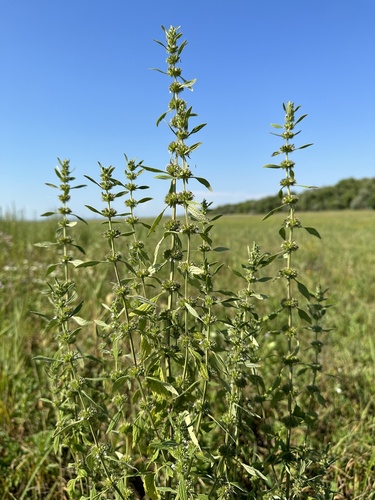
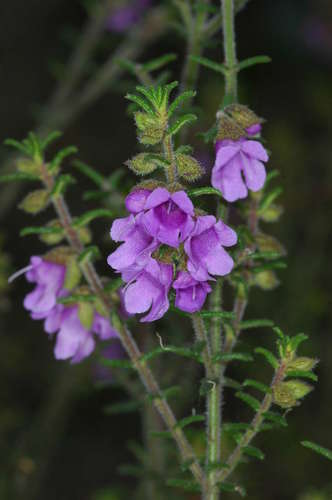
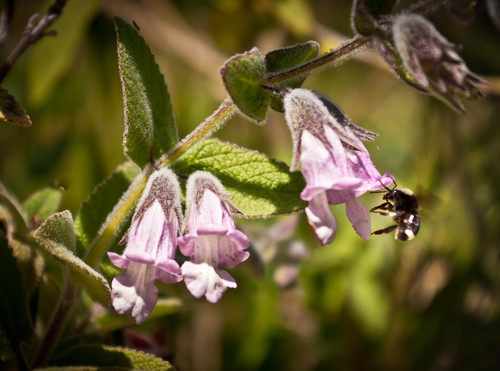
Lepechinia fragrans is a vase-shaped herbaceous shrub that reaches 60 centimeters to just under 2 meters in height, with a spread equal to its height. It usually grows taller in shade and somewhat shorter in full sun. The plant itself is light green, but its dense covering of hairs gives it a fuzzy grayish-green appearance. The entire plant is hairy, bearing long nonglandular hairs and stalkless or short-stalked glands. A pleasant scent is released when the glands are touched. Its arching branches become woody toward the base of the plant. As a member of the mint family, it has characteristically square stems, a feature that is very pronounced in this species. Its leaves can be deltate-lanceolate or ovate-lanceolate, with smooth or slightly serrated edges. Lower leaves are petioled, generally larger, growing up to 12 centimeters long. Upper leaves are typically smaller, as short as 4 centimeters long, and often lack petioles. Like many California native plants, this species produces two distinct sets of leaves. Larger, lusher leaves grow during the winter rainy season; some of these leaves are shed during the dry season, replaced by smaller, grayer leaves. Flowers can range in color from white to pale pink to medium purple. The calyx has 5 lobes, is slightly two-lipped, and persists as the fruit develops. As the fruit matures, the calyx enlarges, becomes slightly inflated, and turns purple. The corolla is bell-shaped, 2.5 to 3 centimeters long, and also two-lipped: the upper lip is divided into 4 lobes, while the lower lip is larger and unlobed. The throat of the flower holds two pairs of stamens and a double-lobed style. The fruit is a cluster of four smooth to shiny nutlets that are dark brown to black in color. The nutlets are round to ovate, and measure 2 to 4 millimeters in length. Lepechinia fragrans is endemic to California. It grows in open chaparral areas, dry ravines, rocky slopes, and ridgetops, at elevations between 60 and 1100 meters. It is confirmed to occur in the Trifuno Pass area of the Santa Monica Mountains, the San Gabriel Mountains, and the northern Channel Islands. It may also grow in Ventura County and areas of the southern California coast below Los Angeles County. The species is threatened by development and fire management practices. While it is not listed as a threatened or endangered plant by the State of California or the U.S. federal government, the California Native Plant Society lists it as a fairly endangered plant of limited distribution that should be monitored. In cultivation, Lepechinia fragrans is easy to grow and easy to propagate from seed, but it is often a short-lived ornamental garden plant. According to the book California Native Plants for the Garden, it has "the most attractive flowers and most pleasing scent of all our native pitcher sage species". It is pollinated by bumblebees. It will grow in full sun or light shade, and performs best in well-drained soils. Plants should be pinched back to encourage a more compact, fuller growth habit. The cultivar 'El Tigre' bears darker blooms, with more purple coloring on the calyx and bracts.