About Leopardus guttulus (Hensel, 1872)
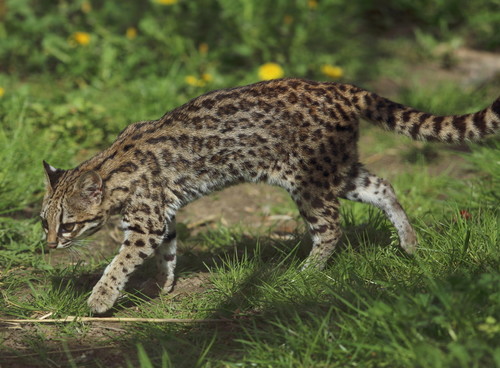
The southern tigrina, scientifically named Leopardus guttulus (Hensel, 1872), has a yellowish-ochre coat marked with open black rosettes. It is slightly darker than the oncilla, has larger rosettes, and a slightly shorter tail. However, it is extremely hard to tell the two species apart by appearance alone, as genetic variation within each species is greater than variation between the two species. Adult southern tigrinas weigh between 1.9 and 2.4 kg (4.2 and 5.3 lb).
The southern tigrina is distributed from central to southern Brazil, specifically in Minas Gerais and Goiás states within the Atlantic Forest, as well as in eastern Paraguay and northeastern Argentina, all below elevations of 2,000 m (6,600 ft). Its total population is roughly estimated to hold around 6,000 mature individuals. It lives in dense tropical and subtropical rainforests, deciduous and mixed pine forests, open savannahs, and beach vegetation. At the edges of its range, the southern tigrina interbreeds with Geoffroy's cat. It does not interbreed with oncilla populations in northeastern Brazil, which have a history of interbreeding with the pampas cat L. colocolo. Habitat differentiation prevents interbreeding between southern tigrinas and oncillas. In contrast, hybridization and introgression happen between southern tigrinas and Geoffroy's cats at their contact zone in southern Brazil. Many southern tigrinas and Geoffroy's cats are thought to be partial hybrids due to the high level of ongoing interbreeding.
In terms of behaviour and ecology, the southern tigrina mostly preys on small mammals, birds and lizards. Most of its prey weighs less than 100 g (0.22 lb), but it also hunts larger prey up to 1 kg (2.2 lb). The southern tigrina often shares habitat with the ocelot. In areas with dense ocelot populations, southern tigrinas have smaller populations because of competition. When ocelots are scarce, smaller cat species like the southern tigrina gain better access to shelters, food and territory, which allows the southern tigrina to reach larger population sizes and higher densities. This observed pattern is called the ocelot effect. In 2015, two juvenile southern tigrinas were recorded for the first time in the Atlantic Forest while they were learning hunting skills and capturing a cavy. This observation confirmed that the mother southern tigrina plays an important role in teaching her cubs to hunt and survive in the wild.