About Leonurus cardiaca L.
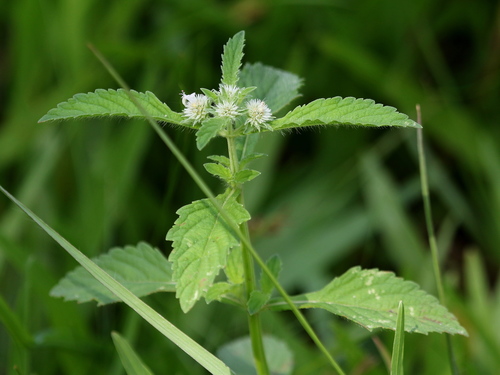
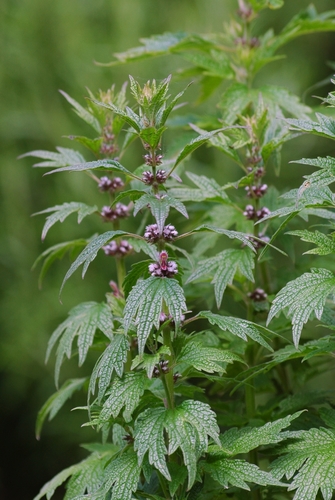
Leonurus cardiaca L. has a squarish stem covered in short hairs, which is often purplish, particularly near the stem nodes. Its leaves grow in opposite arrangements, have serrated edges, are palmately lobed, and borne on long petioles. Basal leaves are wedge-shaped with three points, while upper leaves have three to five lobes. The leaves are slightly hairy on their upper surface, and greyish on their lower surface. Flowers grow in the leaf axils of the upper part of the plant, and each flower is associated with three-lobed bracts. Each flower has a bell-shaped, five-lobed calyx. The corolla is irregular, fused, 8 to 12 mm (0.3 to 0.5 in) long, and shaped as a long tube with two lips. The upper lip is convex and covered with white hairs; the lower lip is three-lobed, curved downward, and marked with red spots. Flower color ranges from pink to lilac, and the lower lip is often furry. There are four protruding stamens, of which two are short and two are longer. The fruit is a four-chambered schizocarp. This plant reaches a height of about 60 to 100 cm (24 to 39 in), and blooms from mid to late summer.
Motherwort is probably native to southeastern Europe and central Asia, where it has been cultivated since ancient times. Its natural habitat is along roadsides, in vacant fields, waste ground, rubbish dumps, and other disturbed areas. It prefers well-drained soil and a partly shady location. This perennial herb was introduced to North America as a foraging plant for bees, to attract bumble bees, and is now considered invasive there. It is hardy in USDA climate zones 4–8.