About Leontice leontopetalum L.
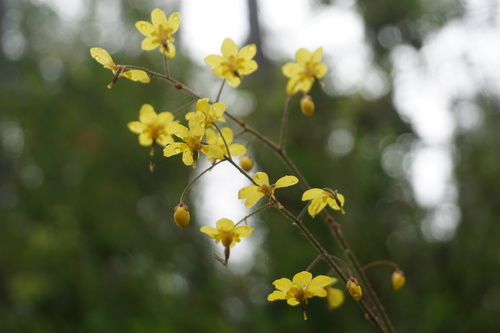
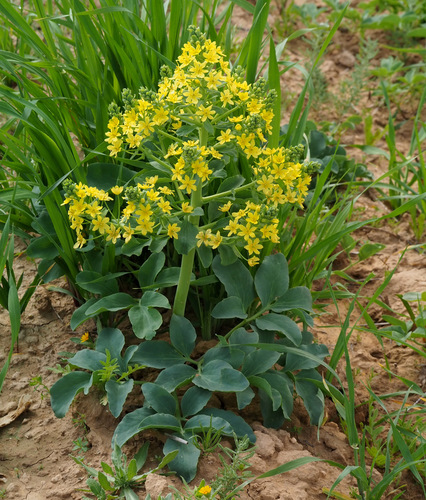
Leontice leontopetalum L. is a perennial herb that reaches 15 to 60 centimeters in height. It produces an abundant yellow inflorescence that can be shaped like a ball or a pyramid. Its flowers bloom between February and April, typically after winter rains. All parts of this plant contain saponins. It has a deep-growing tuberous root that resembles a large potato. Some scholars have observed that the plant's tuber naturally sits as deep as 50 centimeters below the soil surface, which protects it from the Arab plough. The plant's leaves are concentrated at its base, growing directly from the tuberous root, and are divided into large leaflets covered with a waxy coating. Its fully open flowers have six yellow sepals that look similar to petals. The plant produces swollen red fruits, which are dispersed widely when the dry inflorescence detaches from the ground and is blown by wind. Leontice leontopetalum occurs primarily in North Africa, eastern Greece, Southern Bulgaria, and the deserts of the Near East, and is endemic to regions like Israel's Negev. It also grows in semi-dry areas spanning Armenia, Turkey, Northern Iran, and western Pakistan. This species grows in open landscapes in heavy, deep clay soils, at altitudes between 300 meters (980 feet) and 1,100 meters (3,600 feet). It also grows in valleys and washes where loess and alluvial soils are abundant. It is listed as vulnerable (VU) and included in the 2009 Red Data Book of rare and threatened plants of Greece. Local people have used the plant's tuberous roots as soap to remove stains from clothing, particularly cashmere wool. The medieval scholar Ibn al-Baytar recorded that the plant was generally used to clean woollen garments. The plant also has medicinal applications. In Turkey, the root of Leontice leontopetalum, known locally as aslab, has traditionally been used as an antidote for opium overdose. Some scholars have speculated that this plant may be the ashlag (Hebrew: אשלג) described in the Mishnah (Shabbat 9:5; Niddah 9:6), which was used as a cleansing substance. This speculation is based on the similarity between the plant's Arabic name and the Hebrew term, which are thought to be cognates. Bongardia chrysogonum is a related plant with similar flowers, very different foliage, and is thought to share similar properties with Leontice leontopetalum.