About Leonotis nepetifolia (L.) R.Br.
Leonotis nepetifolia (L.) R.Br., also commonly called klip dagga, Christmas candlestick, or lion's ear, is a plant species belonging to the genus Leonotis and the mint family Lamiaceae. It is native to tropical Africa and the Indian Subcontinent, and also grows abundantly across much of Latin America, Southeast Asia, the West Indies, and the Southeastern United States.
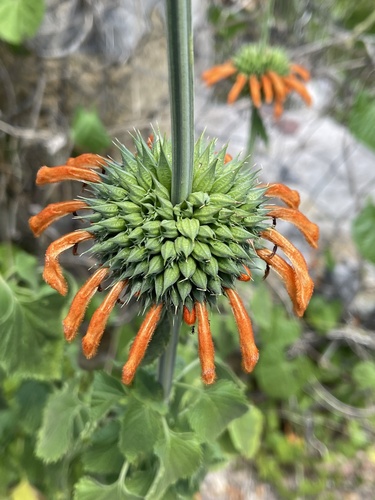
This plant reaches up to 3 metres (9 ft 10 in) in height. It produces whorls of distinctive lipped flowers, which are most often orange, but may also appear in shades of red, white, or purple. Its drooping dark green leaves are very soft, serrated, and can grow up to 10 centimetres (4 in) wide. Sunbirds and ants are attracted to its flowers. It is typically found growing on roadsides, rubbish heaps, and waste land. It is classified as an invasive plant in Australia, Florida, and Hawaii, but researchers studying populations in Hawaii have concluded that its tendency to grow only in disturbed areas means it is not likely to be an ecological threat.
In Trinidad, Leonotis nepetifolia is known locally as shandilay. Its leaves are brewed into a tea that is used to treat fever, coughs, womb prolapse, and malaria, and the tea is claimed to support bone and lung health. The roots of this species are recognized as the botanical source of granthiparna, an ayurvedic herb.