About Leonotis leonurus (L.) R.Br.
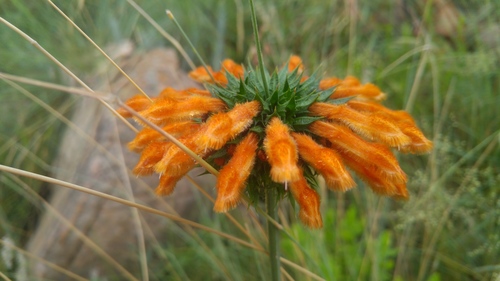
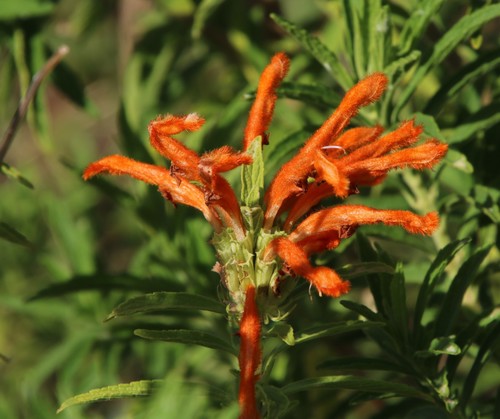
Leonotis leonurus is a shrub that typically grows 2 to 3 metres (7 to 10 ft) tall, and 1.5 metres (5 ft) wide, and rarely reaches up to 4 metres (13 ft) tall. It has softly woody square stems. Its leaves are medium-dark green, 5–10 centimetres (2–4 inches) long, and release an aroma when crushed. The plant produces hairy, tubular orange flowers that measure 4–5 cm long, with 3 to 11 flowers grouped together in tiered whorls called verticillasters, a structure characteristic of the mint family, that encircle the stems. These flower clusters grow up to 0.9 m (2 ft 11 in) above the foliage. It flowers from summer, between November and January, in some regions, and from autumn to winter, between April and June, in others. Leonotis leonurus is native to southern Africa, where it grows naturally in rocky areas and grasslands, most commonly in the wetter eastern and southern parts of the region. It attracts nectar-feeding birds, mainly sunbirds, as well as a range of insects including bees and butterflies. The plant’s characteristic orange to orange-red flower color and tubular shape reflect co-evolution with African sunbirds, which have curved bills adapted to feed from tubular flowers. The butterfly species Cacyreus lingeus, a member of the Lycaenidae family, uses the plant’s foliage as a food source for its larvae. Leonotis leonurus is cultivated as an ornamental plant, valued for its abundant clusters of orange flowers. It is grown as a specimen shrub or used as a screen in gardens and parks. It is moderately drought tolerant, and serves as a nectar source for birds and butterflies in landscape plantings. It was first introduced to Europe in the 1600s. It is grown as an ornamental in other subtropical and Mediterranean climate regions outside of South Africa, including California, Hawaii, and Australia, where it has become naturalized in some areas. In cooler climates, it is grown as an annual, or kept as a conservatory plant over winter. Infusions prepared from the flowers, seeds, leaves, or stems of Leonotis leonurus are widely used in traditional practices to treat tuberculosis, jaundice, muscle cramps, high blood pressure, diabetes, viral hepatitis, dysentery, and diarrhoea. The leaves, roots, and bark are used as an emetic to treat snakebites, and stings from bees and scorpions. Fresh juice from the plant’s stems is made into an infusion drink to treat “blood impurity” in some parts of South Africa.