About Lentinus crinitus (L.) Fr.
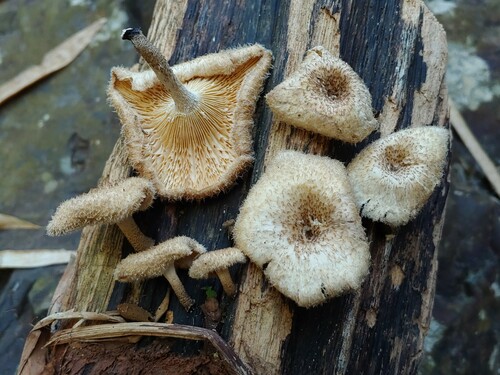
Lentinus crinitus (L.) Fr. produces fruiting bodies that commonly grow in irregular, clustered formations. The cap is 2–5 centimetres (3⁄4–2 in) wide, and its shape can range from flat or slightly convex, to depressed at the center, to funnel-shaped (infundibuliform). When young, the cap surface is whitish, and it matures to yellowish-brown. It is covered with a brownish scruff that can wear away over time. The cap margin is often rolled inward when young, and flattens as the mushroom ages. The stipe can be 1–4.5 cm long and 2–6 mm thick, and it is usually central or off-center (eccentric) relative to the cap; it is cylindrical, and typically has a small basal bulb. The stipe is not hollow, it has a somewhat roughened surface and a leathery texture. It is covered in light yellow scaly hairs (squamulose) along with darker scales (squamules), and it is lighter in color than the cap but follows the same general color profile. The gills are slightly decurrent (they extend a short way down the stipe), are narrow, somewhat forked, and finely toothed (denticulate), with a glandular surface. Gills range in color from pale to dark fuscous, and sometimes have yellowish-brown hairs along their edges. Basidiospores of L. crinitus are white, they measure 5.5–8.0 × 1.8–3.0 micrometres, are broadly rounded with a subtle off-centered point that can point right or left, and have a non-smooth texture. Spores do not react with Meltzer's reagent, and the spore print is white. This species has a monomitic hyphae system with clamp connections. It has generative hyphae and skeletal-ligator hyphae, which differ from typical skeletal hyphae. Skeletal hyphae are generally thick-walled, non-septate, and either unbranched or sparsely branched. In contrast, skeletal-ligator hyphae are highly branched and more flexible, yet still provide more structure and rigidity than generative hyphae alone. These hyphae also connect and bind other hyphal types, contributing to both overall strength and flexibility. Lentinus crinitus is a white rot saprotrophic fungus, meaning it can break down the lignin and cellulose in dead wood to use for energy. It grows on decaying logs in open areas, tropical forests, and mixed oak-dominated forests. Documented dead wood hosts include Nerium oleander, Hevea spp., Hippomane spp., Quercus spp., Barringtonia spp., Nyssa spp., Salix spp., and Rhizophora mangle. This fungus is distributed across 27 countries. In South America, it has been recorded in Brazil, Colombia, Peru, Ecuador, Venezuela, French Guiana, Guyana, and Argentina. In North America, it occurs in the United States (with many observations from Florida) and Mexico. In Central America and the Caribbean, its range includes the Dominican Republic, Belize, Costa Rica, Bahamas, Jamaica, Cuba, Haiti, Martinique, Guatemala, Panama, Honduras, Nicaragua, Trinidad and Tobago, and the Cayman Islands. It is also found in Africa (specifically the Congo and Ethiopia) and in Asia, in the Philippines. It typically occurs at altitudes between 50 and 2,800 metres (160–9,190 ft) above sea level. In the Northern Hemisphere, it is most often found from April to July, and in the Southern Hemisphere from September to December, matching its preference for warmer, wetter summer rainy season climates. Ecologically, L. crinitus is a known potential host for the parasitic fungus Hypomyces aurantius, which parasitizes many species in the family Polyporaceae. Animals may interact with this fungus as a food source; squirrels have been observed eating it, and insects have been reported using it for both food and habitat. Research has found that polysaccharides extracted from L. crinitus basidiocarps show antiproliferative activity against breast carcinoma cells. After treatment, these polysaccharides may activate J774 macrophages, marked by increased production of tumor necrosis factor alpha (TNFα) and nitric oxide, which induces tumor cell death, and these chemicals may improve anticancer activity. Most of the chemical compounds found in L. crinitus were first documented within the Lentinus genus, and studies confirm the fungus produces a variety of biologically active secondary metabolites. Extracts of this species contain the phytochemical 1,3,4-di-O-caffeoylquinic acid, which has shown potential to inhibit the Zika virus. L. crinitus has antimicrobial activity against 11 species of microorganisms, so it can be used as a biological control agent against plant pathogenic fungi and bacteria. It shows particularly strong activity against spores of Aspergillus niger, Aspergillus flavus, and Mucor rouxii. Two compounds extracted from its basidiocarps, 1-desoxyhypnophylline (1) and 6,7-epoxy-4(15)-hirsuteno-5-ol (3), have antimicrobial activity against foodborne and food spoilage microorganisms, including the bacteria Escherichia coli, Listeria monocytogenes, Micrococcus luteus, Pseudomonas aeruginosa, Staphylococcus aureus, Salmonella enterica, Bacillus cereus, and Enterobacter cloacae; and the fungi Aspergillus fumigatus, A. niger, A. versicolor, Penicillium ochrochloron, Talaromyces funiculosus, T. virens, plus two food-isolated fungi: Aspergillus ochraceus and Penicillium aurantiogriseum. There is potential for cultivating this fungus in active agroforestry plantations as an additional source of income, and its cultivation can provide a new nutritional alternative to meet growing global food demand.