About Lentinus brumalis (Pers.) Zmitr.
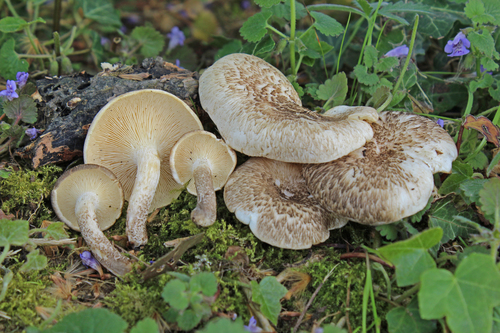
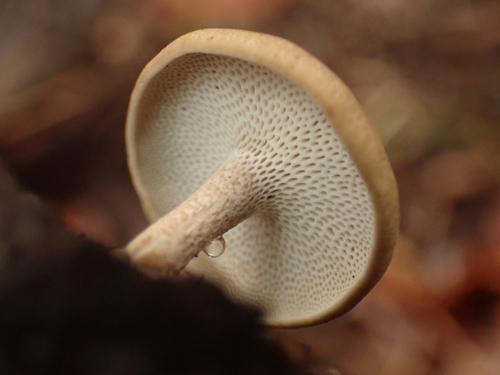
Macroscopic characteristics of Lentinus brumalis: The cap is round and broadly convex, measuring 1.5 to 10 cm (1 to 4 in) in diameter and 0.5 cm (0.20 in) thick. The center of the cap is depressed, and the cap surface is somewhat zoned. The cap surface is dry, and rarely hairy, with color ranging from yellow-brown to dark brown. The cap margin is often inrolled, especially in young specimens. The underside of the cap is white to cream, with 3 mm deep pores. Pores are spaced 2-4 per mm², are (0.5-)1-1.5 mm wide, generally roundish to almost diamond-shaped, and run slightly down the stem (a trait called decurrent), making them slightly elongated. Pores change appearance from dull to lustrous when their orientation relative to light changes. The spore print of Lentinus brumalis is white. The stalk measures 2.5 to 4 cm (1 to 2 in) long and 2–5 mm thick. It is gray to brown, occasionally with red tints, and is generally lighter in color than the cap. The dry stalk surface is either smooth, finely felted, or slightly scaly. The flesh is white, with a consistency ranging from tender to elastic. It has no distinctive taste or odor. Microscopic characteristics: The spores are elliptic to cylindrical, measuring 5–7 × 1.5–2.5 μm. They are smooth and inamyloid, meaning they do not change color when mounted with iodine. The basidia, which are the club-shaped spore-bearing structures, each bear 4 spores and measure 16–22 × 5–6.5 μm. Cystidia, large cells found on the fruiting bodies of some fungi, are absent in this species. Clamp connections are present throughout all tissues. The hyphal system is dimitic, meaning it is made of two types of hyphae. The generative hyphae of the flesh are 4–10 μm wide, colorless, thin-walled, and occasionally branched. The binding hyphae of the flesh share a similar color and width, though they can sometimes swell to up to 13 μm wide. They are thick-walled and nonseptate, are frequently branched, and their branches taper to 1–2 μm wide. A KOH test produces a negative reaction, meaning no part of the fungus changes color in KOH. When stained with guiac gum, the flesh turns blue over a period of 6–12 hours. Ecology and distribution: Lentinus brumalis is saprotrophic, growing on dead hardwoods; it is particularly associated with birch, beech, and mountain ash, and rarely grows on conifers such as hemlock and fir. In Uzbekistan, it also grows on European nettle, willow, and poplar trees. It grows either solitary or in small groups. In North America, it is more common in the eastern region, where it grows from June through October. In Northern Europe, it fruits in late October and March. Uses: The fruiting body of Lentinus brumalis is inedible. It has no use as a dyestuff, because it yields little to no color.