About Leiopelma hochstetteri Fitzinger, 1861
Dorsal Coloration
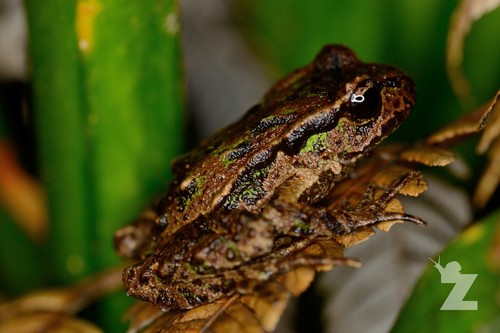
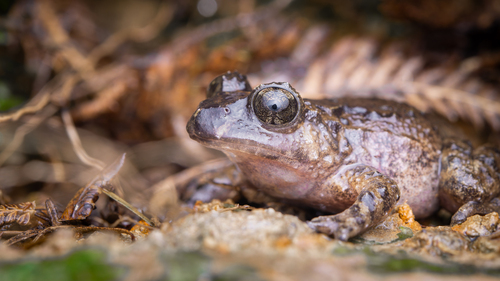
Hochstetter's frog has a dorsal coloration ranging from brown-green to brown-red, marked with dark bands and warts, and yellow-brown bellies.
Size
Males reach a snout–vent length of 38 mm (1.5 in), while females grow up to 50 mm (2.0 in).
Activity Pattern
These frogs are nocturnal, and remain under cover during the day.
Habitat Preferences
They favor moist gaps under shaded debris such as rocks and logs, along streams and seepages in native temperate rainforest.
Diet
They are carnivorous, and hunt invertebrates including spiders, beetles, and mites as prey.
Shared New Zealand Frog Traits
All native New Zealand frogs, called pepeketua in Māori, share the following traits: tail-wagging muscles, inscriptional ribs, round pupils, and an absence of eardrums, eustachian tubes, and vocal sacs.
Sensory Characteristics
In some features these frogs are more similar to salamanders than modern frogs, and rely on chemical signals rather than acoustic signals to mark habitat and recognize competitors.
Vocalization and Hearing
Hochstetter's frog's poor hearing goes along with its lack of vocalization.
Historical Distribution
Subfossil remains show that all native New Zealand frog species were once widespread across the country until around 200 years ago.
Current Distribution Range
Of the native New Zealand frogs, Hochstetter's frog has the largest current distribution, covering the upper North Island of New Zealand.
Range Specific Locations
This range includes the Waitākere and Hunua Ranges, Coromandel Peninsula, Great Barrier Island, Maungatautari Ecological Island, and the East Coast.
Population Genetics
Ten populations of this species are genetically distinct, as a result of a history of glacial isolation.
Current Fragmented Populations
Today, the species persists in fragmented populations across the North Island between Whangārei and the Waikato Region, and also occurs on Great Barrier Island.