About Leifidium tenerum (Laurer) Wedin
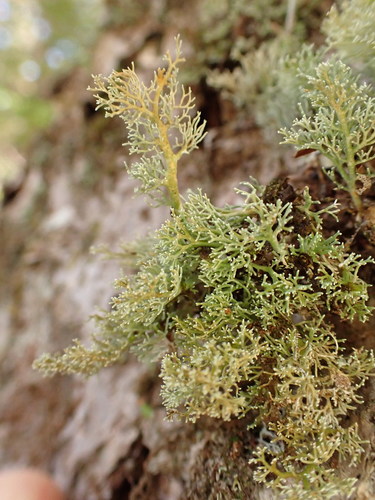
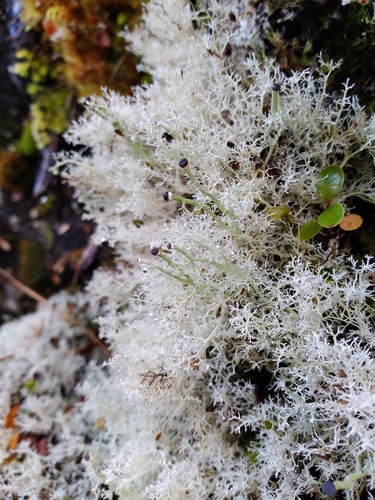
Leifidium tenerum (Laurer) Wedin produces a pale grey to whitish thallus constructed from very slender, round (terete) branches that divide repeatedly, forming loose cushions or low mats over its substrate. Each branch is covered by an extremely thin cortex, only 30–45 μm thick, which consists of just two or three cell layers. This thin cortex keeps branches flexible and often makes the branch tips appear translucent. Under the cortex lies a dense medulla made of tightly packed fungal hyphae (threads). The thread-like, cushion-forming growth habit paired with the very thin cortex easily distinguishes Leifidium from its close relative Bunodophoron, which has flatter branches with a much thicker cortex. This species’ reproductive structures grow at the very tips of stouter, upright side-branches. Each apothecium develops while hidden beneath a cup-like excipulum (wall). When spores are mature, this excipulum detaches as a single piece, “like lifting off a cap”, and exposes an upward-facing powdery spore mass called a mazaedium. The spores themselves are tiny, almost smooth, globe-shaped bodies 6.5–8.5 μm in diameter. They start out colourless, and turn faintly bluish-grey when placed in alkaline solutions; any delicate surface ornamentation on the spores dissolves quickly during chemical testing. Minute flask-shaped pycnidia are scattered across branch tips, and inside them are branched filaments that produce single-celled, broadly ellipsoidal conidia that measure approximately 3–4 × 1.5–2 μm. Chemical analysis has detected the compound sphaerophorin in this species, along with small amounts of unidentified secondary metabolites. While Leifidium tenerum can sometimes look similar to certain species of Cladia or Cladonia, it can be told apart from these genera by its solid thallus—Cladia and Cladonia have hollow branch structures. Leifidium tenerum tolerates a wide range of habitats across the Southern Hemisphere. It grows on alpine and subantarctic soil or rock, and also grows on bark and twigs of trees, tree ferns, lianas, and bamboo in cool-temperate rainforests. It grows most vigorously in moist, well-lit locations. Fertile branches are common at higher elevations and in areas with higher rainfall, while at low altitudes apothecia usually form beside spray zones near waterfalls. This species is found across the southern temperate belt, ranging from Cape Horn north to Temuco in Chile, throughout New Zealand, from Tasmania to central New South Wales in Australia, and across multiple subantarctic islands.