About Legatus leucophaius (Vieillot, 1818)
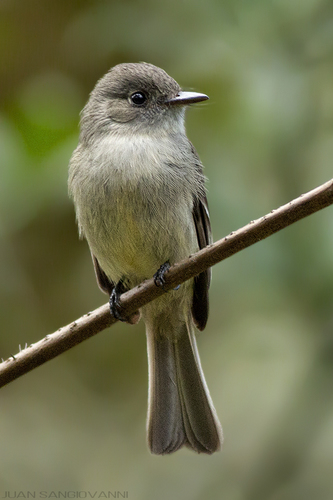
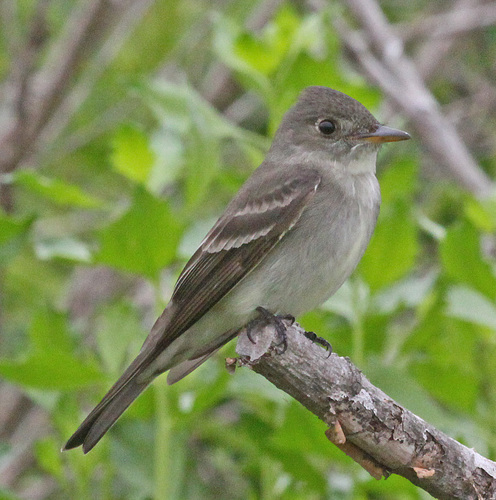
Legatus leucophaius, commonly called the piratic flycatcher, measures 14.5 to 17 cm (5.7 to 6.7 in) in length and weighs 19 to 26 g (0.67 to 0.92 oz). Sexes and the two recognized subspecies share the same plumage pattern, though the subspecies L. l. variegatus is significantly larger than the nominate subspecies. Adult piratic flycatchers have a blackish forehead and crown, with a partially hidden yellow patch on the crown. They have a wide dull whitish supercilium that extends around the head under the crown, with faint grayish streaks toward its rear end. Their lores, ear coverts, and moustachial stripe are dusky, and their cheeks are white. Most of their upperparts are mostly dark grayish brown or dark olive-brown, with pale edges on most feathers. Their uppertail coverts have rusty or cinnamon edges. Their wings are brownish black, with whitish edges on the coverts. Their flight feathers have very thin pale grayish brown edges on primaries, and whitish edges on secondaries. Their tail is dusky brown or blackish brown; the inner and sometimes outer webs of the tail feathers have lighter edges. Their chin and throat are unstreaked whitish. Their underparts are mostly yellowish white or pale yellow, with wide brownish or olive streaks on the breast, sides, and flanks. Their short, wide, stubby bill is mostly brownish black, with a browner base to the lower mandible. They have a brown iris and dusky legs and feet. Juveniles have no yellow crown patch. They have light cinnamon tips on crown feathers, a buffy supercilium, wide cinnamon edges on wing coverts, rusty edges on tail feathers, and paler underparts than adults with few or no streaks. Of the two subspecies, L. l. variegatus is the more northerly distributed. It is found from San Luis Potosí in east-central Mexico, south along the Gulf-Caribbean side of Mexico (except the eastern Yucatán Peninsula), and continues south through Belize, northern and central Guatemala, into northern and eastern Honduras. It also occurs on the Pacific slope of Mexico's Chiapas state, and has been recorded as a vagrant in New Mexico, Texas, and Florida. The nominate subspecies is found from Nicaragua south through Costa Rica and Panama into Colombia. In South America, its range extends south through Colombia, western and eastern Ecuador, and eastern Peru. It extends east through Venezuela and the Guianas, and from there south through Brazil to Mato Grosso and northern Rio Grande do Sul (excluding part of northeastern Brazil), through northern Bolivia and eastern Paraguay, and into northwestern Argentina's Tucumán Province and northeastern Argentina's Corrientes Province. It also occurs on both Trinidad and Tobago, and has been recorded as a vagrant in Uruguay. The piratic flycatcher inhabits a variety of somewhat open landscapes in the tropical and lower subtropical zones. These include secondary forest, gallery forest, humid woodland, the edges of evergreen forest, forest clearings with scattered trees, and agricultural areas. Its maximum elevation varies by region: in Mexico and Central America it mostly occurs from sea level to 1,000 m (3,300 ft), and is found locally up to 1,500 m (4,900 ft); it reaches 1,600 m (5,200 ft) in Colombia, 800 m (2,600 ft) in Ecuador, 1,400 m (4,600 ft) in Peru, and 1,000 m (3,300 ft) in both Venezuela and Brazil.