About Lechea maritima Legg. ex Britton
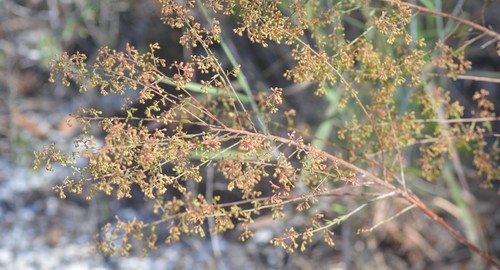
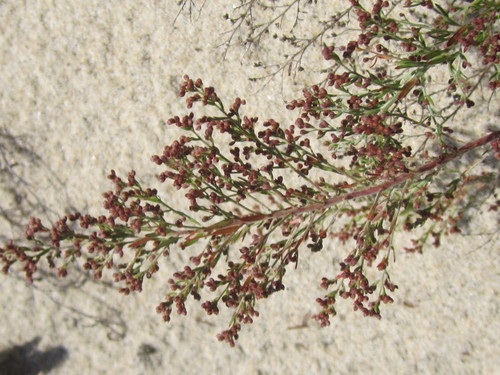
Lechea maritima is visually distinct from other Lechea species. It is characterized by dense white trichomes, oblong leaves on basal shoots, and a bushy-branched growth habit. These dense white trichomes separate it from Lechea intermedia (narrowleaf pinweed), the other pinweed found in its northern range. It shares several traits with Lechea racemulosa: narrowly elliptic stem leaves, three-veined sepals, and pedicels that thicken below the calyx. This species flowers from mid to late summer, and its fruits develop from late summer to early fall. Its radial shoots do not start forming until late autumn, and continue developing until December. Its flowering stems grow 20 to 35 centimetres (8 to 14 inches) tall and are extensively branched. Beach pinweed, the common name of this species, is found almost exclusively along the Atlantic coast of North America, ranging from New Brunswick to North Carolina. It extends inland for approximately 150 kilometres (93 miles) into Massachusetts and New Hampshire. In the early 1910s, it was recorded as one of the most common plants on the island of Nantucket, where it grew in pure sand. It is often found growing alongside Hudsonia tomentosa, another member of the rock rose family.