About Leccinum vulpinum Watling
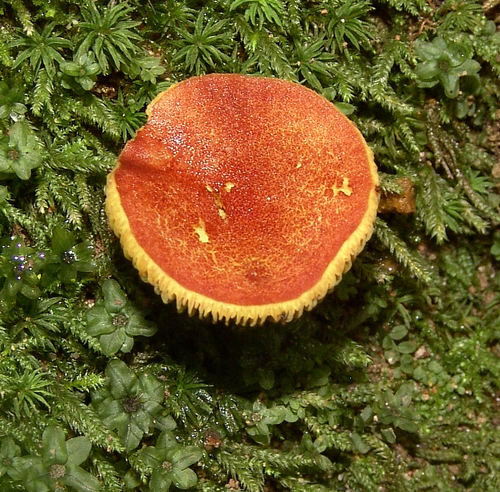
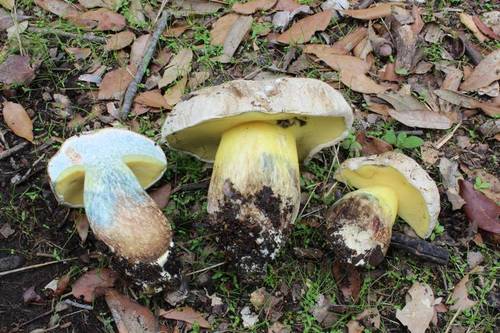
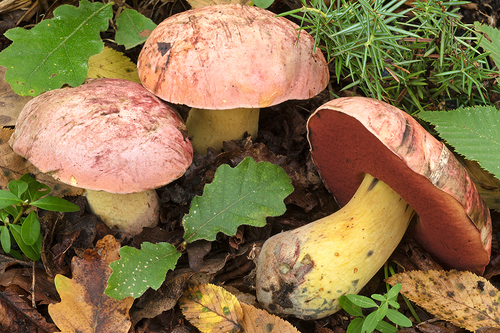
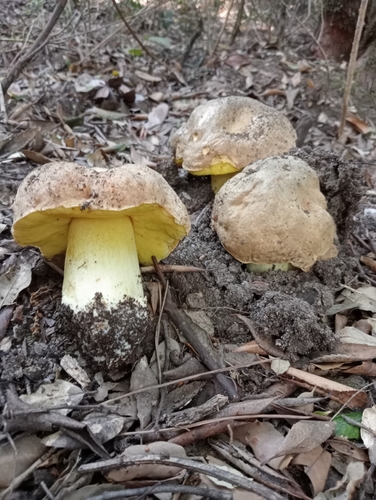
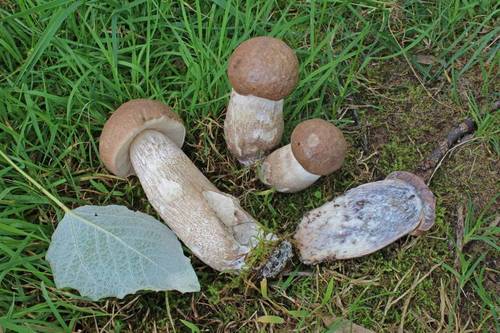
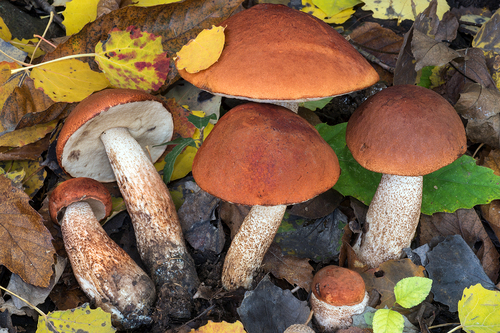
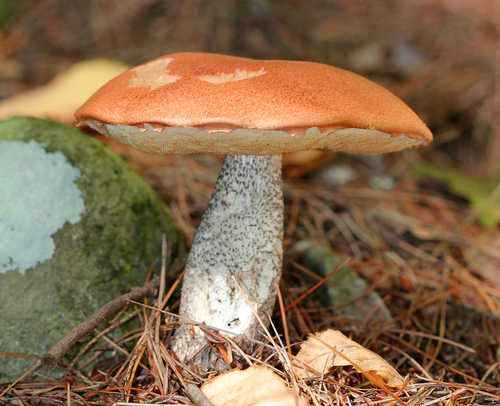
Fruit bodies (basidiocarps) of Leccinum vulpinum Watling have caps that measure 30–90 mm in diameter. Caps are convex when young, becoming broadly convex with age, and have a dry surface covered in fine, woolly fibrils that are darkest at the center. Cap color is a muted fox-red with a cocoa-brown tint, maturing to a deeper burnt sienna; bruising may produce a purplish-sienna hue. On the underside of the cap, the pore surface is pale cream, with small, round pores that may bruise faintly lilac. The tubes are 3–11 mm long, and are broadly attached (adnate) to scarcely free from the stipe. The stipe is 85–135 mm long and 13–22 mm wide, reaching up to 28 mm wide at the base; it is stout, stuffed, pallid overall, and slightly swollen toward the base. It bears fine scales that change color from whitish to reddish-brown, and finally to dark brown or chocolate. The base of the stipe often bruises blue-green. Flesh throughout the fungus is white, and may remain unchanged in the cap. When staining does occur, changes are very slow: it first becomes pale pink or wine tinted in the stipe apex, then blue-green in the cortex at the base, and ultimately turns patchy steel-blue. The odour is mild and pleasant, and the taste is gentle and not distinctive. Microscopic features include smooth, spindle-shaped (subfusiform) spores about 12–16.5 by 3–4 μm, which are brown in mass; four-spored basidia measuring 16.5–20 by 8–10 μm; and ventricose to fusiform cystidia measuring 30–35 by 10–13.5 μm, with a 2–3 μm-wide neck. Leccinum vulpinum is an edible mycorrhizal fungus that forms associations with pine species and bearberry, and it forms specific mycorrhiza with Scots pine (Pinus sylvestris). It was originally recorded from dry, upland pine woods in Inverness-shire, Scotland. Specimens were collected among bilberry (Vaccinium myrtillus) under mature pines in the Rothiemurchus area and Cairngorms National Park, with known collections made between 1957 and 1960. It has a broader distribution across Europe, and has been recorded in several additional countries including Poland, Portugal, Macedonia, and Montenegro.