About Leccinum versipelle (Fr.) Snell
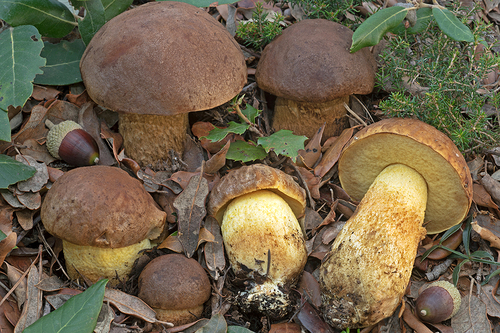
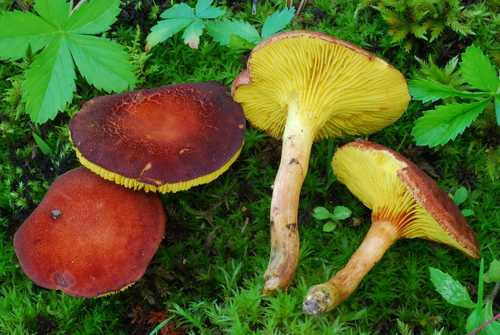
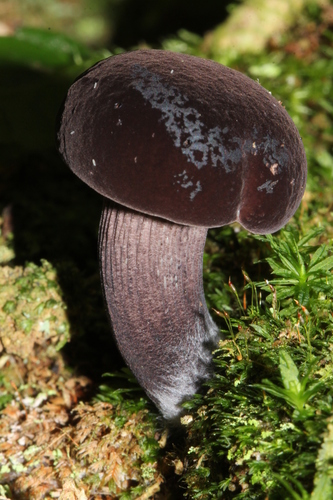
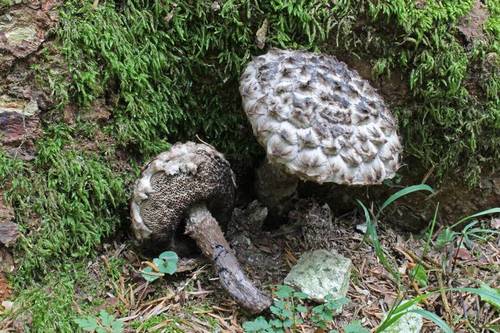
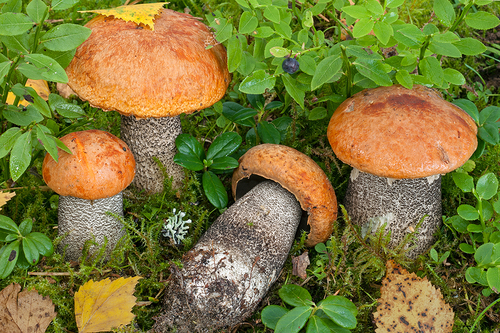
Leccinum versipelle (Fr.) Snell has a broadly convex cap, which ranges in color from buff to yellow-orange, ochre, bright red-brown, or brick red. The cap surface is felty, and can reach up to 15 centimetres (6 inches) in diameter. Its flesh is white to pink; when cut, it stains reddish, then changes to avellaneous, and finally becomes fuscous. The tubes are 8 to 22 millimetres long, colored yellowish white to brownish grey, and turn violaceous to greyish when bruised. Pores are 0.5 millimetres in diameter, colored greyish white to grey ochre, and discolor to brownish when bruised. The stipe is firm, long, and slender. It is white, covered lightly to densely with fine greyish to blackish, sometimes whitish, squamules; squamules are sometimes coarser near the base of the stipe. Stalks can grow up to 15 cm tall and 3.5 cm wide, are whitish, and have many raised black dots. Its spores are brown, or smokey to blackish-brown, shaped fusiform, and measure (9.0—) 11.5—16.5 x 3.5—4.0(—5.0) μm. The spore print is yellow-brown to olive. For distribution and habitat, Leccinum versipelle fruits on the ground either solitary or in groups. It forms ectomycorrhizal associations with Betula birch, and grows in forests and heathland, on sandy, slightly acidic, loamy soils. It can be found across Europe from August to November.