About Leccinum holopus (Rostk.) Watling
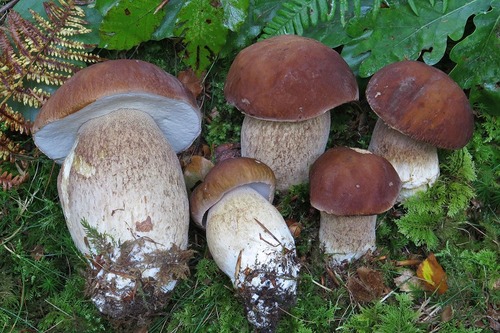
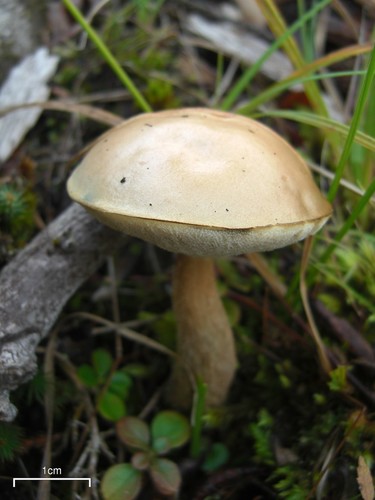
Leccinum holopus fruitbodies have convex to flattened caps 3–10 cm (1.2–3.9 in) in diameter, with a narrow band of sterile tissue around the cap margin. Caps start out whitish, and develop gray, buff, tan, or pinkish tints as they mature; older caps may darken and take on a greenish color. Young cap surfaces are covered in very fine hairs, becoming roughly smooth over time, and are often sticky when mature or in moist conditions. The fruitbody flesh is white, with no distinct odor or taste. When injured, most variants show little to no bruising color change, though the variety americanum may turn light pink. The cap underside is a porous surface, with 2 to 3 pores per millimeter. Each pore is the opening of a tube that grows up to 2.5 cm (1.0 in) deep. The pore surface ranges in color from whitish to grayish to dingy brown. It usually has little color change when injured, but may discolor yellowish or brownish. There is a depression at the point where the pores attach to the stipe. The stipe is 8–14 cm (3.1–5.5 in) long and 1–2 cm (0.4–0.8 in) wide. Its whitish surface is covered with small raised scabers that darken to tan or a darker color with age. The base of the stipe often stains bluish. Leccinum holopus produces a brown spore print. Its spores are somewhat spindle-shaped (fusoid), and measure 14–20 by 5–6.5 μm. The four-spored spore-bearing cells (basidia) measure 28.5–36.5 by 11.5–12.5 μm. Cystidia on the pores are flask-shaped (lageniform) to fusiform, measuring 39.0–45.5 by 7.5–9.0 μm. Cystidia on the stipe (caulocystidia) are fusiform, club-shaped, or cylindrical, measuring 39.0–54.5 by 9.1–13.5 μm. There are no clamp connections in the hyphae of Leccinum holopus. The cap cuticle forms a cutis, with hyphae arranged parallel to the cap surface. Several chemical tests can help confirm identification of Leccinum holopus. A drop of ammonium hydroxide solution turns the cap cuticle pinkish, and produces no reaction with the flesh. A drop of dilute potassium hydroxide (KOH) produces no reaction on the cap surface, and produces either no reaction or a brownish reaction in the flesh. Iron(II) sulfate solution produces no reaction on the cap surface, and produces either no reaction or a slight olive color change in the flesh. Leccinum holopus is a mycorrhizal species. It produces fruitbodies on the ground, often growing among Sphagnum moss, growing singly or scattered in wet locations including cedar swamps, bogs, and soggy forests. Like most Leccinum species, this fungus is highly host-specific and forms mycorrhizal associations with birch (Betula). In North America, its range stretches from eastern Canada to New York, extending west to the northern Rocky Mountains, and roughly matches the distribution of paper birch (Betula papyrifera). It is common within this range, and fruits from August to October. The variant L. holopus var. americanum is only found in North America. The fungus is rare in southern Europe, but more common in Sphagnum swamps in northern Europe. In Asia, it has been recorded from Taiwan and Qinghai, China. Leccinum holopus fruitbodies are eaten as a food source by fly species including Pegomya winthemi (family Anthomyiidae) and Megaelia pygmaeoides (family Phoridae).