About Leccinum aurantiacum (Bull.) Gray
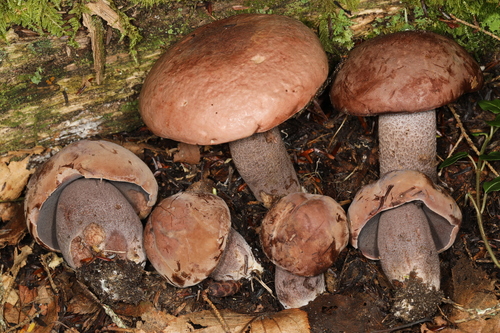
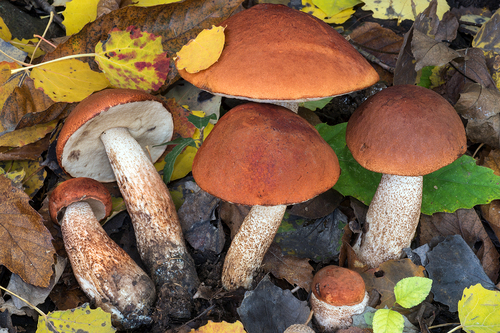
The cap of Leccinum aurantiacum is orange-red, and measures 5–15 centimetres (2–6 inches) across. Its flesh is white; when bruised, it first turns burgundy, then changes to grayish or purple-black. The underside of the cap has very small, whitish pores that bruise to olive-brown. The stem is 8–16 cm (3–6+1⁄2 in) tall and 2–3 cm (3⁄4–1+1⁄4 in) thick, and can bruise blue-green. The stem is whitish, with short, rigid projections called scabers that turn from brown to black as the mushroom ages. Leccinum aurantiacum fruits during summer and autumn in forests across Europe and North America, and forms mycorrhizal associations with host trees. In Europe, it has traditionally been associated with poplar trees, and is also found growing with oak and a range of other deciduous trees including beech, birch, chestnut, willow, and trees of the genus Tilia. It is not known to form associations with conifers in Europe. In North America, populations have been recorded in both coniferous and deciduous forests, but it is uncertain whether collections from coniferous forests are actually L. vulpinum. Furthermore, collections from North American deciduous forests have been assigned to other North American species such as L. insigne and L. brunneum, meaning L. aurantiacum may be entirely absent from North America.