About Leccinellum rugosiceps (Peck) C.Hahn
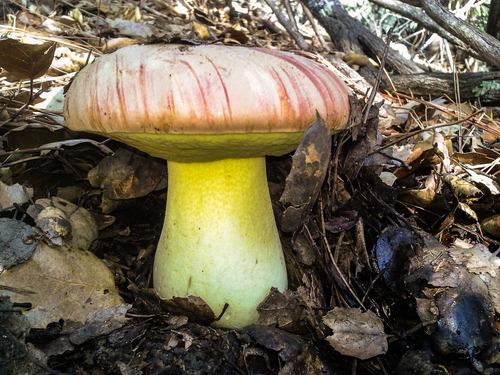
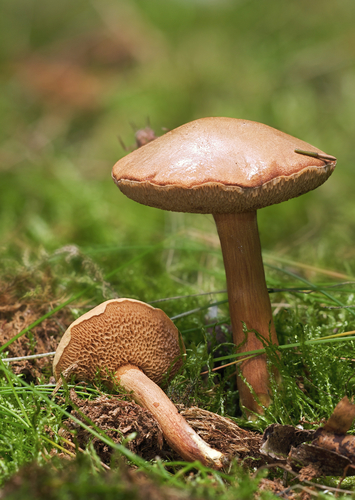
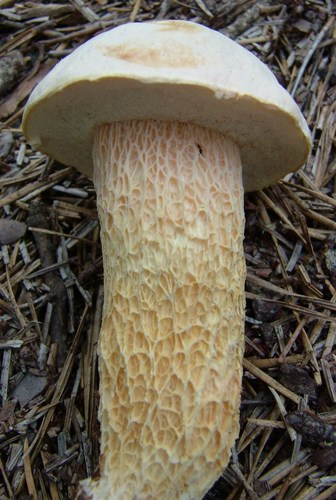
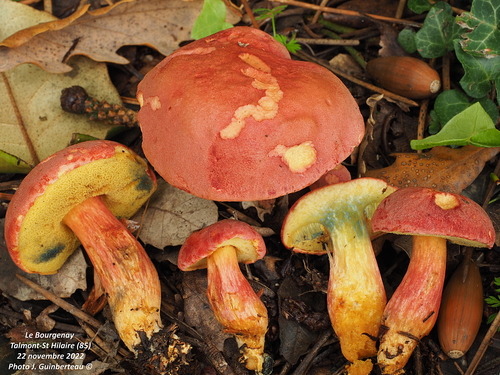
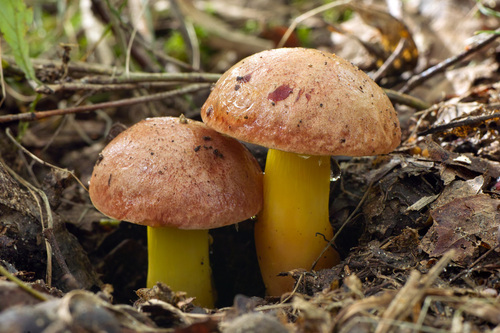
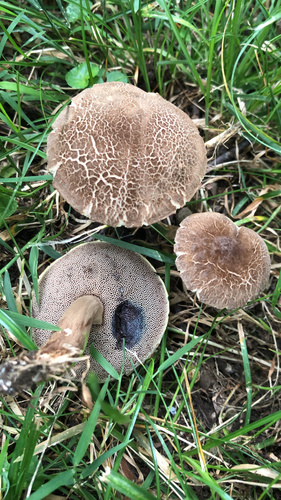
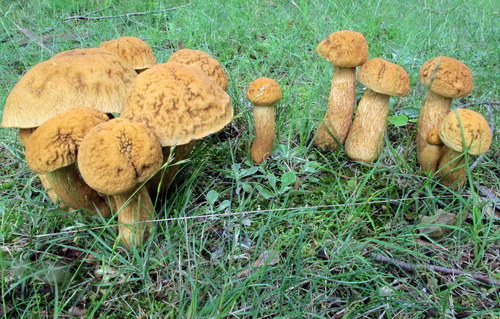
The convex cap of Leccinellum rugosiceps measures 5–15 cm (2.0–5.9 in) wide, and is orange-yellow when young, aging to yellow-brown. The cap margin has a narrow flap of sterile tissue. The cap surface is dry, with wrinkles and pits when mature, and often cracks with age, revealing the whitish flesh underneath. The cap changes color significantly throughout its growth: starting bright yellow, then turning dark brown, and finally ending pale tan. This variable coloration can make the species difficult to identify in the field. The flesh is white to pale yellow, and stains reddish to burgundy when cut or bruised. This staining reaction is most prominent at the junction between the cap and the stipe. After further 20–60 minutes of exposure, the stained flesh turns grayish to blackish. The flesh has no distinctive odor or taste. The pore surface is dull yellow initially, and sometimes ages to dingy olive-brown. Unlike many other boletes, Leccinellum rugosiceps does not turn blue when bruised, though it may naturally have blue-green stains. The pores are circular, measuring less than 1 mm across, and the tubes they sit in are 8–14 mm deep. The stipe measures 3–10 cm (1.2–3.9 in) long by 1–3 cm (0.4–1.2 in) thick, and is roughly equal in width along its length or tapers from top to base. Beneath its pale brown scabers (which darken with age), the stipe is pale yellow to brownish. The spore print color ranges from brown to olive-brown. Spores are spindle-shaped, measuring 15–19 μm long by 5–6 μm wide, with a smooth surface, and are inamyloid (meaning they do not stain when tested with Melzer's reagent). The cap flesh is bilateral and also inamyloid. Conspicuous pleurocystidia and cheilocystidia are present on the pores. The cap cuticle forms a hymeniform layer, and clamp connections are absent. Several chemical tests can help confirm identification of L. rugosiceps: a drop of ammonium hydroxide solution turns the cap cuticle reddish or is unreactive, and turns the flesh yellow or is unreactive; a drop of dilute potassium hydroxide (KOH) turns the cap surface red, and the flesh yellowish to orangish; application of iron(II) sulfate solution produces a gray color on the cap surface, and a greenish-gray to olive color on the flesh. Leccinellum rugosiceps is an ectomycorrhizal fungus that forms associations with oak trees. In eastern North America, pin oak (Quercus palustris) is a frequent host. The bolete fruits singly or in groups in forests and shaded lawns, and is often found in areas disturbed by human activity such as pathsides and picnic areas. Fruiting typically occurs from July to September. A Chinese study measuring heavy metal concentrations in boletes found that cadmium, zinc, copper, and mercury levels in L. rugosiceps fruitbodies exceeded national safety standards for edible fungi. In North America, L. rugosiceps is found from eastern Canada south to Florida and Mississippi, and west to Michigan in the United States. Its distribution extends south to Mexico, Costa Rica, and Colombia, and it is one of several bolete species that follow a north-to-south clinal trend. In Asia, the species has been reported from India, Korea, China, and Taiwan. Specimens collected from Taiwan tend to have slightly smaller spores (10–16 μm by 4–5 μm) than those collected from mainland China or the Americas.