About Leccinellum lepidum (H.Bouchet ex Essette) Bresinsky & Manfr.Binder
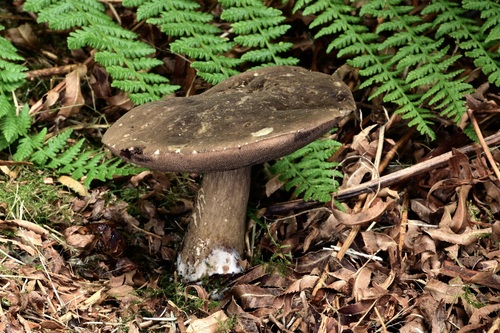
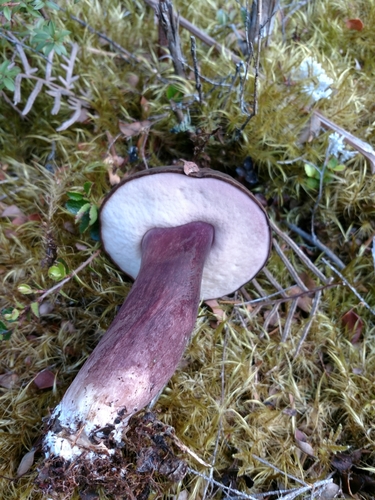
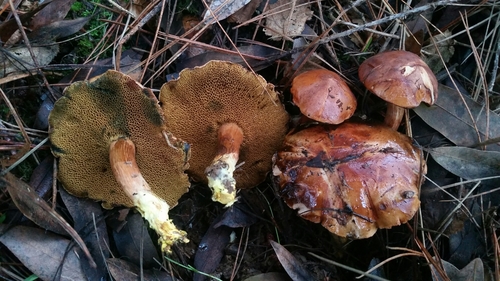
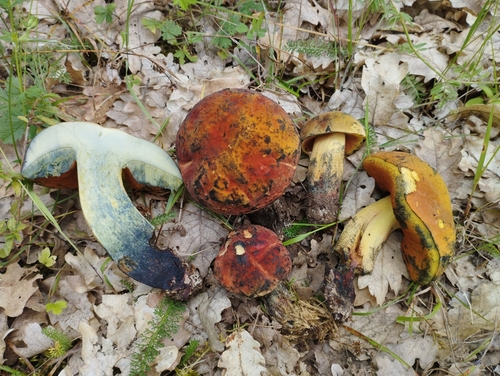
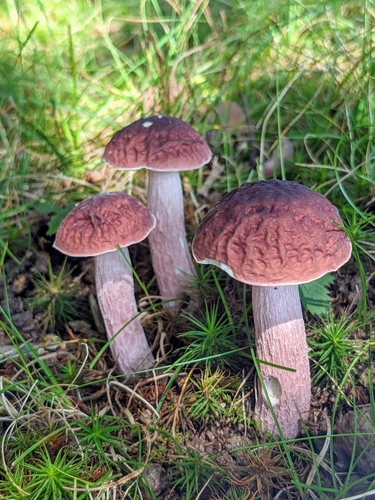
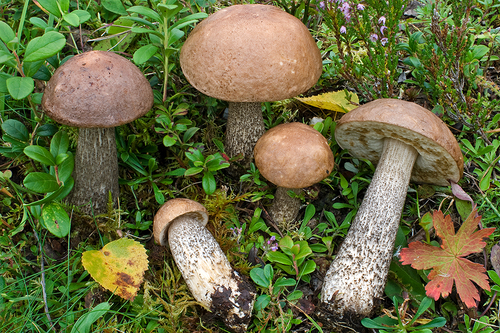
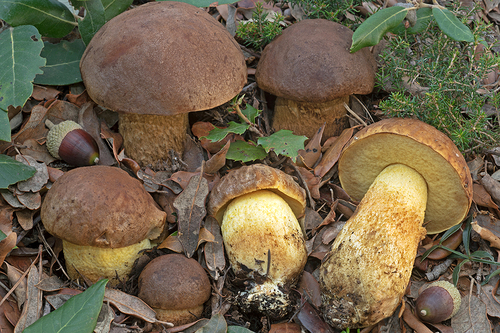
Leccinellum lepidum produces large, fleshy fruit bodies. Its cap starts hemispherical, and gradually becomes convex or convex-flat as the fungus expands, reaching a diameter of 6 to 20 cm (2.5 to 8 in). The cap cuticle is smooth to somewhat lobed, often with a "hammered" appearance, and is moderately to strongly viscid in wet weather. Cap color ranges from ochraceous yellow to ochraceous brown, chestnut-brown, or blackish brown in very old specimens. The tubes are more or less free from the stem, 1 to 2 cm (0.5 to 1 in) long, and pale yellow to ochraceous yellow. The pores are small and rounded, match the color of the tubes, and slowly stain rusty-brown, and finally greyish brown when handled or as they age. The stem is 5 to 15 cm (2 to 6 in) long by 2 to 6 cm (1 to 2.5 in) wide, usually stout and initially short-ventricose, but gradually becomes longer and clavate to cylindrical. Stem color ranges from ochraceous yellow to pale yellow, straw-coloured, or dirty white. The stem surface is covered in tiny pustules called scabrosities, which match the stem surface color when young, but often stain rusty-brown or grey-brown with age, and sometimes coalesce to form an incomplete false net, called a pseudoreticulum. The flesh is thick and dull yellow to straw-coloured. When cut or exposed to air, it very slowly discolours orange or violaceous-grey in parts, and darkens to greyish-brown or grey-black after a few hours. Young specimens have a weak fungoid smell, which becomes stronger in old specimens, while the taste is mild to somewhat astringent. Spores are tobacco-brown when produced in mass. Under a microscope, spores appear narrowly ellipsoid to fusiform, or spindle-shaped, and measure 13.5–22 × 5–6 μm. The cap cuticle is a trichodermium of septate cylindrical hyphae, often finely incrusted. This species is widespread in the Mediterranean region, where it forms ectomycorrhizal associations with various species of oak. It is most commonly associated with evergreen members of the "Ilex" group, particularly the holm oak (Quercus ilex), but also the golden oak (Quercus alnifolia), the kermes oak (Q. coccifera) and the Palestine oak (Q. calliprinos). In the western parts of the Mediterranean basin, it is frequently found under the cork oak (Q. suber), and collections under the semi-deciduous Portuguese oak (Q. faginea) have also been reported. It has no preference for substrate type, and occurs abundantly on both calcareous and acidic soil. Though it is a southern species, the fungus is notable for its late fruiting season and tolerance to low temperatures. In a 10-year study conducted on the island of Cyprus, L. lepidum was the most frequently recorded bolete, making up over half (61%) of all Boletaceae collections found during the winter months of December–February.