About Lecanora polytropa (Hoffm.) Rabenh.
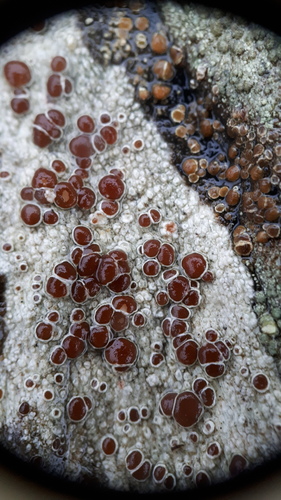
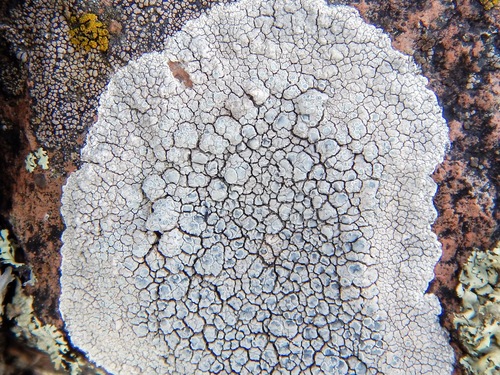
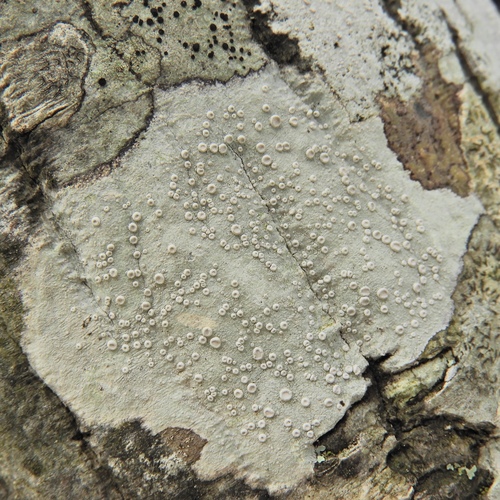
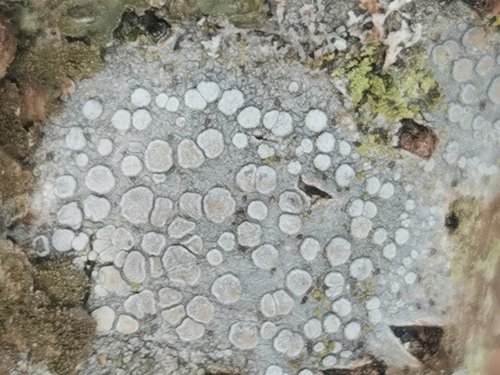
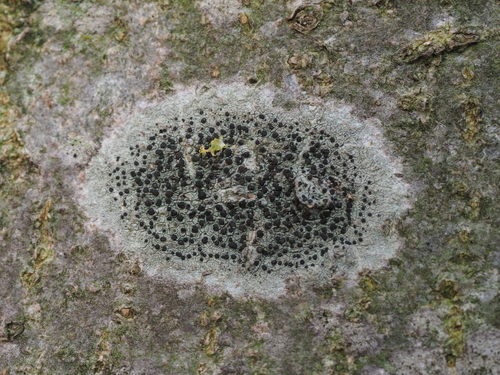
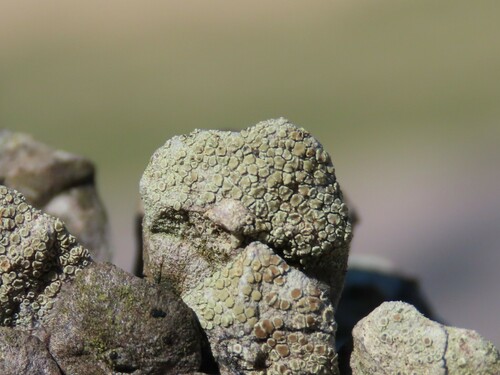
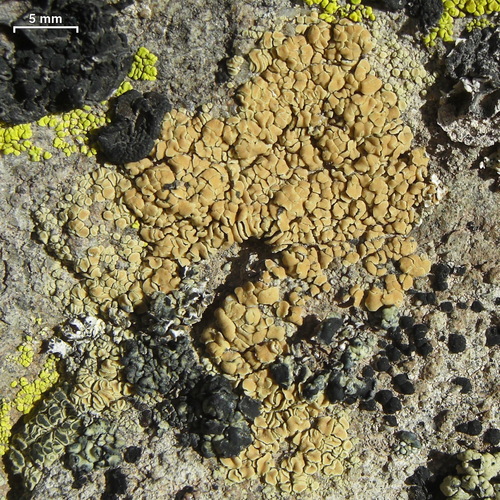
Lecanora polytropa (Hoffm.) Rabenh. has a sparse thallus that sometimes looks like tiny pale yellowish areoles. Its tiny, flat apothecia usually measure 0.3–0.9 mm in diameter, and may grow either scattered or clustered together. The apothecia have a waxy texture, range in colour from yellow to pale orange, and have no pruina. Their margins are smooth, not prominent, and are typically lighter in colour than the central apothecial disc. The ascospores of this species are ellipsoid, measuring 8–15 by 5–7 μm. This lichen grows on siliceous rock, especially granite, and prefers sites with full sun exposure. It is common on exposed granite boulders and outcrops across its range, but is easily overlooked because of its small size. Lecanora polytropa has a cosmopolitan distribution, and occurs on all continents. It is found in both maritime and continental Antarctica, including the Antarctic Peninsula, Queen Mary Land, and Victoria Land. In a study of saxicolous lichen community structure on rock faces within a 4-kilometre (2.5-mile) radius of Japan’s Mount Tokachi volcano, researchers found that Lecanora polytropa grows well in the volcanic environment near active fumaroles, an environment that many other species cannot tolerate. Its tiny thalli can fit into small depressions and cracks in rock, which helps it establish a foothold and start colonising rock surfaces even when exposed to weathering from high winds and storms. Lecanora polytropa also takes part in the succession of lichens that grow on gravestones, and tends to persist long after it first colonises the surface. This species was one of three lichens discovered growing at an altitude of 7,400 m (24,300 ft) on Makalu in Nepal – this marks the highest recorded elevation at which lichen has been found.