About Lebia grandis Hentz, 1830
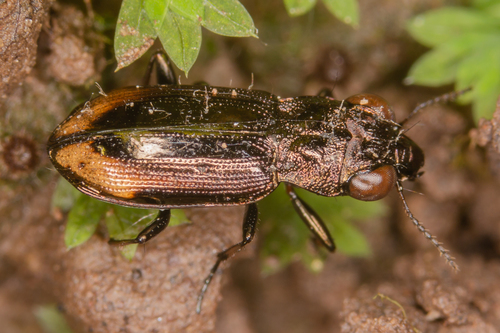
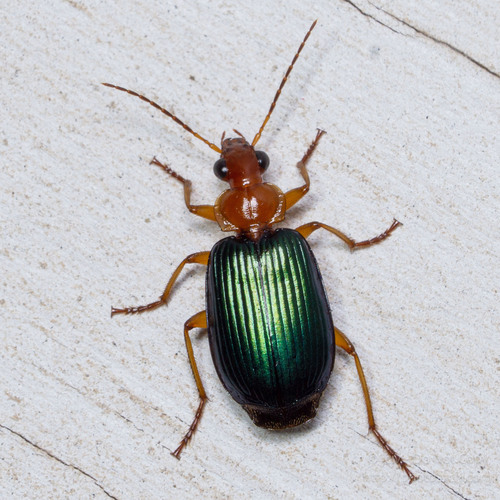
Lebia grandis is the largest species in its genus that occurs in North America. Adults are around one centimeter long, with a rusty orange head, thorax, and legs, a black abdomen, and an iridescent blue or purple sheen on their dark-colored elytra. The elytra are wide but somewhat shorter than the abdomen, which sticks out past their posterior end.
Adult Lebia grandis ground beetles overwinter in soil located in or near potato fields. In spring, Colorado potato beetles emerge from hibernation. When Lebia grandis emerges a few weeks later, eggs and young larvae of its prey are already available for adult feeding, and suitable host pupae will soon be available for attack by Lebia grandis larvae. An adult Lebia grandis can eat approximately twenty-three Colorado potato beetle eggs, or three third instar Colorado potato beetle larvae, each day.
After mating, females lay eggs one at a time in soil near potato plants. A glandular secretion makes soil granules cling to the eggs, which camouflages them. Each female can lay up to 1,300 eggs over the course of several months. Eggs hatch after about two weeks, and first instar larvae seek out Colorado potato beetle larvae that are getting ready to pupate. These larvae may follow an odor trail left by burrowing Colorado potato beetle larvae, and must reach the host's pupation chamber before it closes. Once there, they insert their mandibles into the host's integument to feed, which kills the host. After molting, they stop feeding and soon metamorphose into the pupal stage. Adult ground beetles emerge around three weeks after the original eggs hatched.
The role of Lebia grandis in controlling Colorado potato beetle populations was not fully understood at first, because adult beetles are mostly nocturnal, and larvae live underground. In fact, it was around one hundred years after this species was first described that researchers discovered the parasitoid habit of its larvae. Because Lebia grandis specifically targets Colorado potato beetles and is native to North America, it shows potential for use as a biological control agent in the United States. However, it does not usually reach high enough population numbers to fully control Colorado potato beetle on its own. Populations may need to be increased by releasing adult beetles, but mass rearing of these beetles still has unsolved difficulties that prevent this approach. While other predators like the spotted lady beetle Coleomegilla maculata also prey on Colorado potato beetle, Lebia grandis is tied to potato fields by its reliance on chrysomelid larvae as hosts, unlike other predators that can disperse to other food sources.