About Lavia frons (É.Geoffroy Saint-Hilaire, 1810)
Scientific Name and Body Size
The yellow-winged bat, scientifically named Lavia frons, has a total length of 58–80 mm (2.3–3.1 in) and a body weight of 28–36 g (0.99–1.27 oz). Females are typically slightly larger than males, with an average wingspan of 36 cm.
Pelage Coloration
The species’ fur, called pelage, is made up of long hairs that are usually pearl grey or slaty gray. Males may have greenish-yellow fur on their hindparts and ventral body surfaces.
Wing and Membrane Color
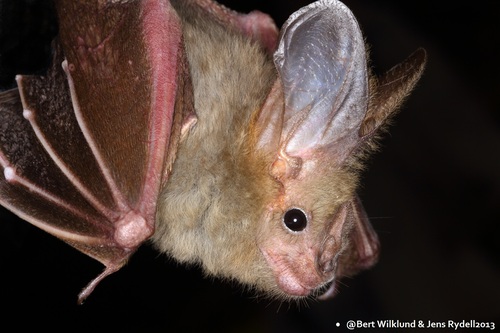
As its common name suggests, this bat has reddish-yellow wings; this same color appears on its other membranes, noseleaf, and ears. Most of the membranes are hairless, though there is some fur on the upper arms.
Ear Structure
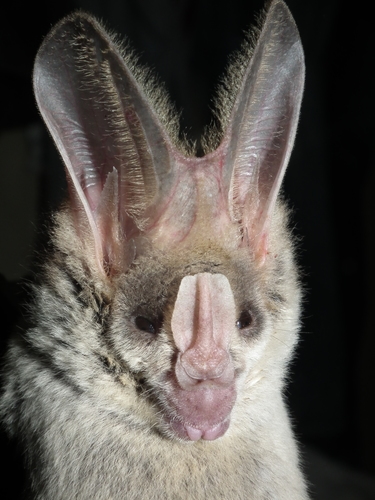
Its ears are fairly long and feature a spiky tragus.
Noseleaf Structure
It has an elongated noseleaf with a blunt but pointed tip.
Interfemoral Membrane and Tail
While the yellow-winged bat has an advanced interfemoral membrane, it has no external tail.
Dental Formula
Its dental formula is 0.2.1.1 / 1.2.3.3.
Male Specialized Glands
Males have glands on the lower back that secrete a yellow substance.
Female Specialized Features
Females have false nipples near the anus, which young bats use to hold on.
Species Range
The yellow-winged bat has an extensive range across sub-Saharan Africa, extending south to northern Zambia.
General Habitat
It mostly occupies woodland and savannah habitats at elevations below 2,000 m.
Preferred Vegetation and Location
It prefers acacia trees and thorn bushes near bodies of water, and flies around these water sources. It favors areas with well-spaced vegetation, which lets it see more of its surroundings.
Roost Site Types
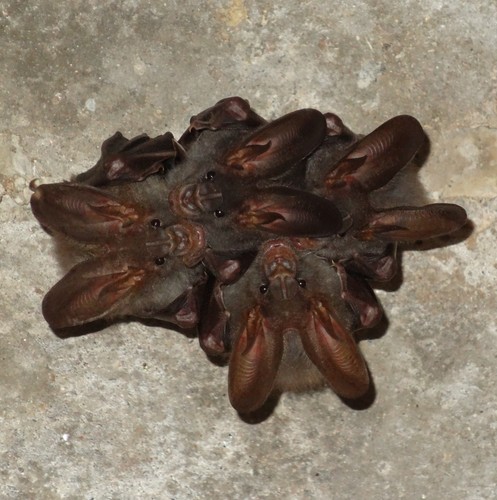
The yellow-winged bat primarily roosts in small trees and shrubs, but can also be found roosting in tree cavities and buildings. It uses two separate roost trees: a primary roost and a peripheral roost.
Roost Use Patterns
Bats use the primary roost in the morning and again before evening. They travel between the primary and peripheral roost trees, especially on hot days when they need shade.
Roost Flight Behavior
These flights are usually short, but longer midday flights have been recorded.
Diet Composition
Unlike other false vampire bats, the yellow-winged bat feeds exclusively on insects, not small vertebrates. It eats both soft-bodied and hard-bodied insects, including termites, scarab beetles, orthopterans, lepidopterans, and dipterans.
Prey Size
Prey can range from very small to relatively large.
Feeding Strategy
The yellow-winged bat is a sit-and-wait predator: it perches and listens for prey, and launches an attack when prey flies past.
Predator Vulnerability
While this species may be vulnerable to predation, it is very alert. Known predators include eastern green mambas, bat hawks, Blanding's cat snakes, and common kestrels.