About Laurelia novae-zelandiae A.Cunn.
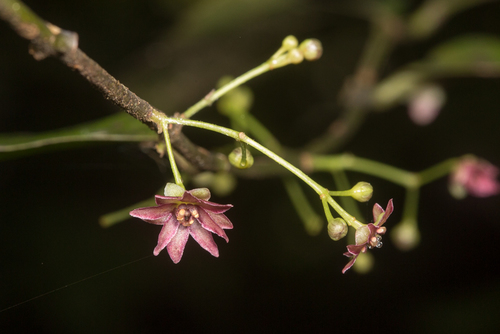
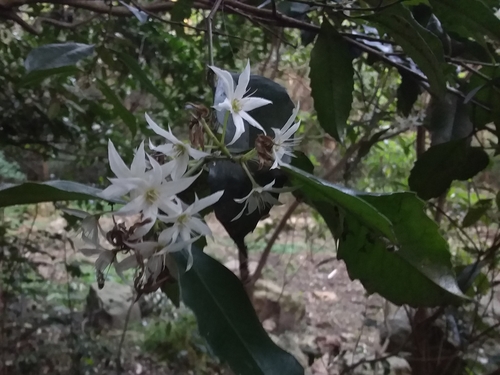
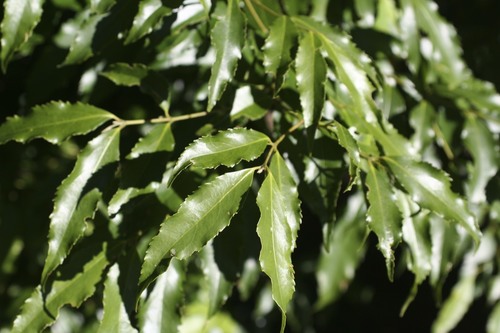
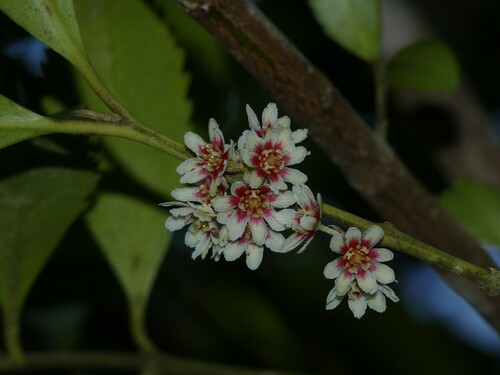
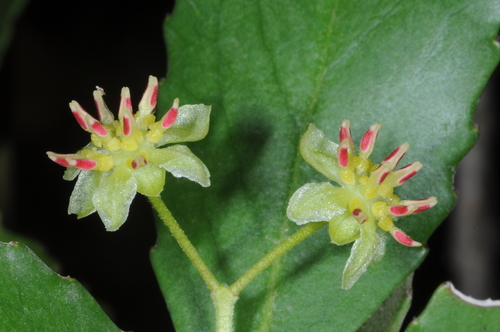
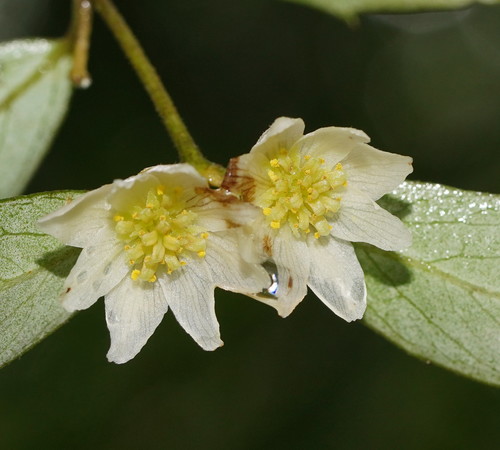
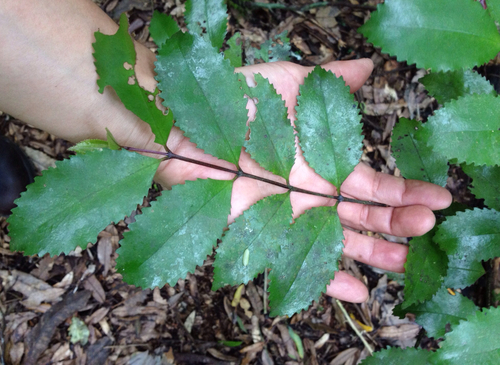
Laurelia novae-zelandiae, common name pukatea, grows slowly to an eventual height of 40 m (130 ft), and most mature individuals reach 35 m (115 ft). It is the only native New Zealand tree that develops large plank buttresses to support its growth in swamps or areas with shallow soil. In waterlogged ground or mud, this species also grows specialized respiratory root structures called pneumatophores. These fragrant trees are a characteristic component of the lower strata of tropical rainforest. Pukatea has thin bark, and its pale brownish-grey trunk becomes prominently and attractively buttressed at its base. Its leaves are dark green, glossy, and elliptical, measuring 5–7 cm (2.0–2.8 in) long; they have coarsely serrated edges and paler undersides. These odorous, opposite leaves contain oil cells in their parenchyma, and have brochidodromous venation. Juvenile leaves and stems of pukatea are often hard to tell apart from those of hutu, another native New Zealand tree that is only distantly related to pukatea. Pukatea is mostly a dioecious species, meaning male and female flowers grow on separate individual trees. Some individual specimens have been recorded with a ratio as high as 100 male flowers for every female or hermaphrodite flower, which indicates the species is not truly strictly dioecious. Female and hermaphrodite flowers of pukatea are very similar in appearance. The flowers are tiny, inconspicuous, and arranged in small racemes. These star-shaped flowers are pale, with yellow glistening glands and scarlet anther flaps. Glands located at the base of the stamens secrete nectar that accumulates at the base of the flower. This nectar attracts large numbers of bees, blowflies, small flightless animals, and Bombyliidae to the flowers. The nectar appears as a colourless, glistening liquid on the outer surfaces of the glands; ongoing secretion causes the nectar to run down from the glands and accumulate on the floor of the flower. The fruit is a small pear-shaped capsule that holds numerous achenes, each attached to fine feathery strands that help disperse the seeds by wind. Often, only a small number of the produced seeds are viable. As individual pukatea trees age, they frequently develop large hollows at the center of their trunks. Pukatea is endemic to New Zealand. It is generally found in lowland forest, growing across the entire North Island of New Zealand and the northern third of the South Island. It most often occurs in locations with plentiful moisture, including damp lowland forests, gullies, and stream edges. While it grows well in poorly drained soil, it also thrives on hillsides. It requires a temperate to warm subtropical climate, and a mostly frost-free environment that only experiences very slight winter frosts no colder than −4 °C (25 °F), paired with high summer heat. It grows best on well-drained, slightly acidic soils that are rich in organic matter. In traditional Māori rongoā medicine, this plant is used as an analgesic, because the alkaloid pukateine is present in its bark. Traditional Māori communities also used the large central hollows of old trunks as burial trees. Māori used pukatea timber to carve canoe figureheads, as well as to make bowls, clubs, and paddles. Early European settlers also adopted pukatea wood for boat building. Pukatea wood is soft, yet very strong. It produces a pale hardwood that is difficult to split, and will dent rather than break upon impact. It is pale-yellowish, visible growth rings, homogeneous, and fine-textured. The pulp of the tree's cambium can be boiled in water to produce a liquid that has been used to treat tuberculosis.