About Lauraceae
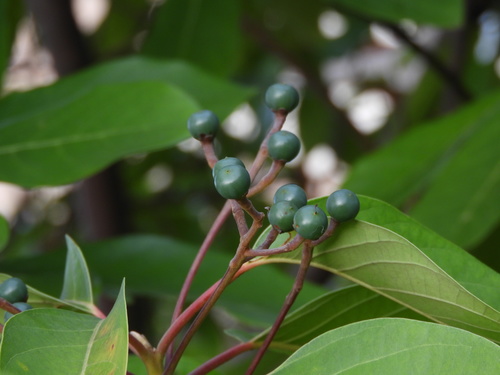
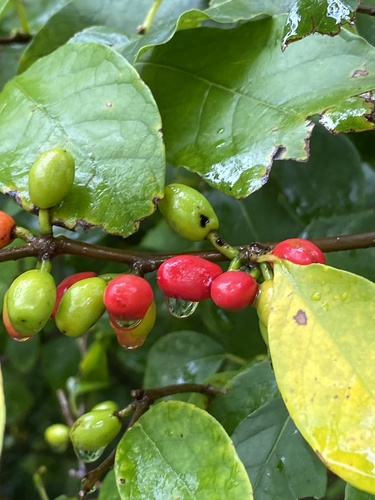
Most members of the Lauraceae plant family are evergreen trees. The only exceptions are around two dozen species of Cassytha, which are all obligately parasitic vines. The fruits of Lauraceae are drupes, one-seeded fleshy fruits with a hard endocarp layer surrounding the seed. However, the endocarp is very thin, so Lauraceae fruits resemble single-seeded berries. In some species, especially those in the genus Ocotea, fruits are partly immersed in or covered by a thick, cup-shaped or deep cupule. This cupule forms from the calyx tube where the peduncle connects to the fruit, giving the fruit a similar appearance to an acorn. In some Lindera species, fruits grow a hypocarpium at their base.
Because the Lauraceae family is very ancient and was once widely distributed across the Gondwana supercontinent, modern species commonly grow in relict populations isolated by geographical barriers such as islands or tropical mountains. Relict forests hold endemic fauna and flora in communities that are very valuable for studying paleontological succession and climate change that followed the breakup of supercontinents.
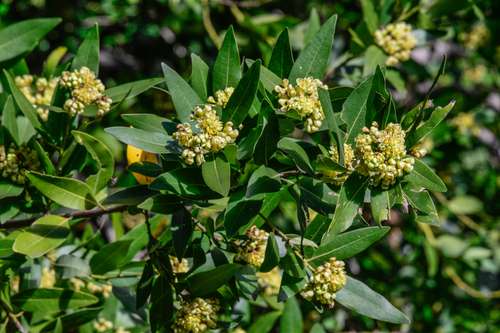
Many Lauraceae species contain high concentrations of essential oils. Some of these oils are valued for use in spices and perfumes. Within the plants, most of these aromatic substances are components of irritant or toxic sap or tissues that repel or poison many herbivorous or parasitic organisms. Some of the essential oils are valued as fragrances; for example, they were used to make the traditional laurel wreath of classical antiquity, and fragrant woods from the family are prized in cabinet making for making insect-repellent furniture chests. Some Lauraceae products are valued for cooking: bay leaves are a popular ingredient in European, American, and Asian cuisines, and avocados are important oil-rich fruits cultivated in warm climates around the world. Many species are harvested for timber, and some are valued as sources of medicinal material. Well-known genera with commercially valuable species include Cinnamomum, which produces cinnamon (Cinnamomum verum) and cassia (Cinnamomum cassia); Camphora, which includes the camphor tree (Camphora officinarum); Laurus, which includes bay laurel (Laurus nobilis); and Persea, which includes avocado (Persea americana). Loss of habitat and overexploitation for these products, including overcutting, extensive illegal logging, and habitat conversion, has left many species at risk of extinction. Conversely, some species that are commercially valuable in some countries are considered aggressive invaders in other regions. For example, Cinnamomum camphora, which is valued as an ornamental and medicinal plant, is so invasive that it has been classified as a weed in subtropical forested areas of South Africa.
Lauraceae flowers are protogynous, and often have complex flowering systems to prevent inbreeding. Lauraceae fruits are an important food source for birds, and some Palaeognathae are highly dependent on them. Other bird groups that rely heavily on these fruits for their diet include members of the families Cotingidae, Columbidae, Trogonidae, Turdidae, and Ramphastidae, among others. Specialized frugivorous birds tend to eat whole fruits and regurgitate intact seeds, releasing the seeds in locations favorable for germination in a process called ornithochory. Other birds that swallow whole fruits pass intact seeds through their digestive tracts. Seed dispersal for various Lauraceae species is also carried out by monkeys, arboreal rodents, porcupines, opossums, and fishes. Water dispersal (hydrochory) occurs in the genus Caryodaphnopsis.
The leaves of some Lauraceae species have domatia in the axils of their veins, which are home to certain mites. Other lauraceous species, particularly members of the genus Pleurothyrium, have a symbiotic relationship with ants that protect the tree. Some Ocotea species are also used as nesting sites by ants, which may live in leaf pockets or hollowed-out stems. Defense mechanisms used by Lauraceae members include irritant or toxic sap or tissues that repel or poison many herbivorous organisms.
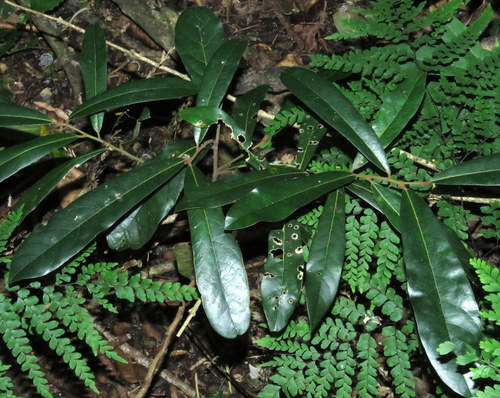
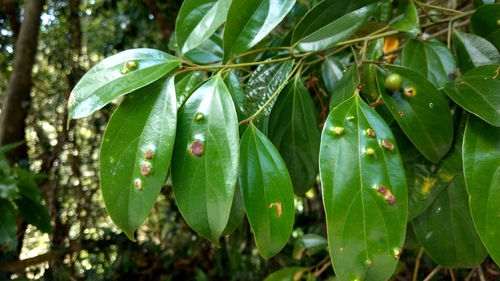
Lauraceae trees dominate the world's laurel forests and cloud forests, which grow in tropical to mild temperate regions of both the northern and southern hemispheres. Other members of the family grow pantropically in general lowland and Afromontane forest; for example, in Africa there are species endemic to Cameroon, Sudan, Tanzania, Uganda and Congo. Several relict Lauraceae species grow in temperate areas of both hemispheres. Many species in other plant families have foliage similar to Lauraceae due to convergent evolution, and forests made up of these similar plants are called laurel forest. These plants are adapted to high rainfall and humidity, with leaves that have a thick waxy layer that makes them glossy, and a narrow, pointed-oval shape with a drip tip that lets leaves shed excess water to allow transpiration to continue. Scientific names that reference Daphne (such as Daphnidium, Daphniphyllum) or "laurel" (such as Laureliopsis, Skimmia laureola) belong to plant species from other families that resemble Lauraceae. Some Lauraceae species have adapted to the demanding conditions of semiarid climates, but they tend to depend on favorable soil conditions, such as perennial aquifers, periodic groundwater flows, or periodically flooded forests in nutrient-poor sand. Various species have adapted to swampy conditions by growing pneumatophores: roots that grow upward, projecting above the level of periodic floods that drown competing plants that lack this adaptation.
Paleobotanists have suggested the family originated approximately 174±32 million years ago, while other researchers argue the family is no older than the mid-Cretaceous. Fossil flowers attributed to Lauraceae have been found in Cenomanian clays from the mid-Cretaceous (90–98 million years ago) of the Eastern United States (Mauldinia mirabilis). Lauraceae fossils are common in Tertiary strata of Europe and North America, but the family virtually disappeared from central Europe in the Late Miocene. Because of their unusual fragility, Lauraceae pollen does not preserve well, and has only been found in relatively recent geological strata. Deciduous Lauraceae members lose all their leaves for part of the year based on rainfall variations; leaf loss coincides with the dry season in tropical, subtropical, and arid regions.
Laurel wilt disease, caused by the virulent fungal pathogen Raffaelea lauricola native to southern Asia, was first detected in the southeast United States in 2002. The fungus spreads between host plants via a wood-boring beetle, Xyleborus glabratus, with which it has a symbiotic relationship. Multiple Lauraceae species are affected by the disease. The beetle and fungus are believed to have arrived in the US via infected solid wood packing material, and have since spread to several states.