About Launaea intybacea (Jacq.) Beauverd
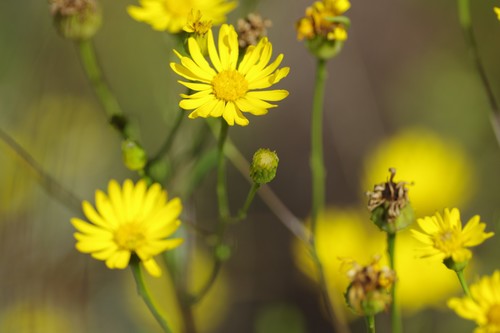
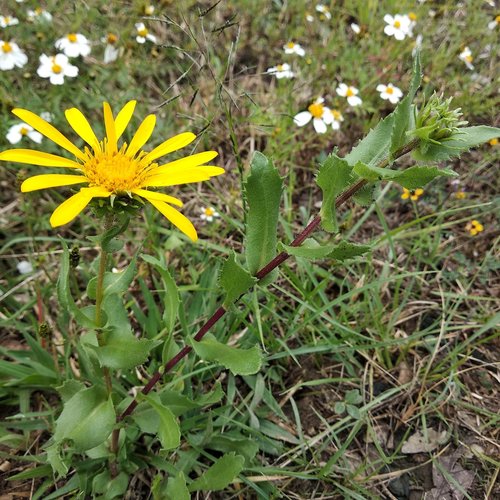
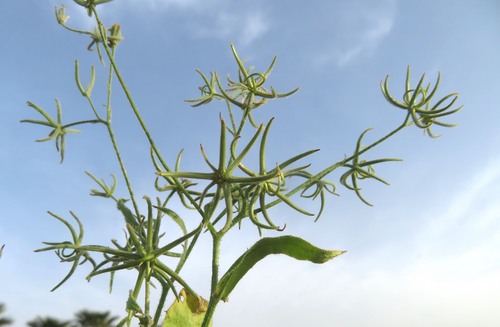
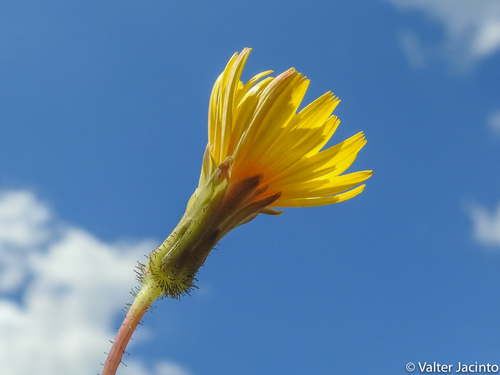
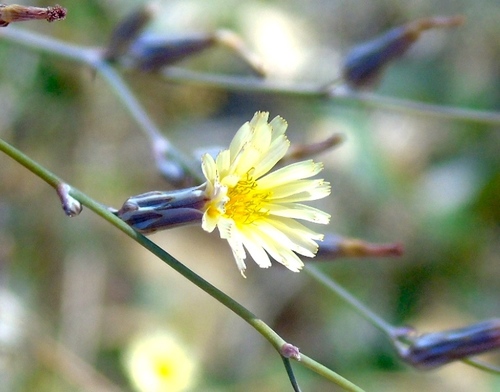
Launaea intybacea (Jacq.) Beauverd is an erect annual or biennial herb that grows up to 1 meter (3 feet 3 inches) tall. In its early developmental stages, it may form a rosette of basal leaves. Its hairless stems can be either branched or unbranched. Its leaves often have purple lower surfaces, can grow up to 28 centimeters (11 inches) long and 11 centimeters (4.3 inches) wide, and have margins that range from shallowly to deeply toothed. Leaf tips taper to a slender point, and leaf bases taper toward the stem, forming a "winged" petiole. Flowering heads occur either singly or in small clusters on short peduncles. Each head holds 15 to 35 small flowers called florets, which have pale to bright yellow corollas up to 9 millimeters (0.35 inches) long. All corollas are long, slender, and tongue-shaped, rather than cylindrical. The florets grow from within a green, pear-shaped to cylindrical structure called an involucre, which is made of overlapping bracts; the inner bracts are 2 to 3 times longer than the outer bracts. The margins of these bracts are noticeably thin and pale. Each floret produces a dry, one-seeded fruit of the cypsela type. When mature, this fruit is topped with numerous spreading white bristles that reach up to 9 millimeters (0.35 inches) long.
Worldwide citizen science observation locations on iNaturalist show that Launaea intybacea occurs in warmer regions across the globe, ranging from the Americas to southern Europe, Africa, and the Indian subcontinent. It is notably absent from southeastern Asia and Australia. The species is native to Africa, and was introduced to the Caribbean and Central America from West Africa during the early trans-Atlantic slave trade.
Launaea intybacea is a drought-adapted weed that is capable of spreading rapidly in disturbed areas. Photographs on the source page show an individual plant growing at the edge of a sidewalk next to the seawall of a small coastal town on Mexico’s Gulf of Mexico coast.
In Ethiopia, Launaea intybacea is considered a famine food. In non-famine conditions it is uprooted as a weed, but during periods of famine, its leaves are boiled to reduce their natural bitterness. Green Deane, author of the popular book Eat the Weeds with Green Deane, warns that raw plants of this species are bitter and require cooking: "Don't be surprised if you have to boil leaves 40 minutes or so in a lot of water to make it edible."
In Saudi Arabian traditional medicine, all parts of Launaea intybacea are used to treat a wide range of ailments, including jaundice, skin diseases, liver disorders, and dry coughs. The plant is also believed to improve digestion and promote lactation in women. Laboratory analyses have confirmed that compounds from the plant exhibit anti-inflammatory, antithrombotic, and antitumor effects. A study conducted on albino rats specifically validated the traditional use of Launaea intybacea to treat liver disorders.