About Latua pubiflora (Griseb.) Baill.
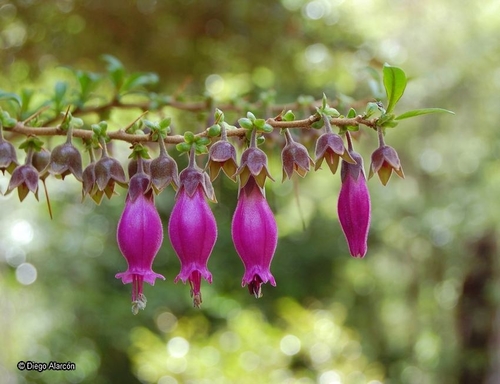
Latua pubiflora (Griseb.) Baill. is a woody, spiny, evergreen, heteroblastic plant that grows 2–10 m tall. It has one trunk when growing as a tree or several trunks when growing as a shrub; trunks are 3–40 cm in diameter and spread upward and outward from the base. Its bark is thin and grey-green, marked with corky longitudinal fissures, and becomes reticulate, somewhat rough, and coloured reddish to greyish brown or buff. Branches are smooth, grey-green, and bear spines. Current year’s growth takes the form of cylindrical branchlets covered in yellowish-brown pubescence, which become hairless as they age. Spines are rigid and erect, developing from modified branches in leaf axils, reaching up to 2 cm in length; they usually have a small leaf at the base and one or two tiny cataphylls near the apex. Leaf blades measure 3–12 cm long by 1.5–4 cm wide, and are covered in fine hairs; leaf petioles are approximately 2 mm long. Flowers are pendent and borne in late winter to early spring. Flower pedicels are tomentose and 5–20 mm long. The calyx is 8–10 mm long and densely pubescent. The corolla is urceolate (urn-shaped), coloured magenta to red, 3–4 cm long and around 1.5 cm wide at its midpoint, with a densely pubescent outer surface. The style is magenta, and bears a bright green, capitate stigma. Stamen filaments are magenta, attached to the base of the corolla for around 8 mm and hairy at their bases; anthers are purple, somewhat heart-shaped, around 2 mm long, and dehisce to reveal ash-grey pollen. The fruit is a globose berry, slightly flattened, yellow to orange-yellow, and around 2 cm in diameter. It sits within a densely hairy, accrescent calyx 11–16 mm long, which has spreading lobes and often splits when the berry is fully ripe. Seeds are thick, slightly longer than broad, around 2 mm long, and dark brown to black. This plant grows only in the narrow coastal cordillera between Valdivia and Chiloé, in southern Chile. This is mountainous difficult terrain with an extremely wet climate and few roads, and existing roads are nearly impassable during the rainy season. Writing in 1971, Plowman noted Latua pubiflora occurs sporadically in these coastal mountains between 40° and 43° latitude, from the province of Valdivia to Chiloé. This region receives over 2540 mm (100 in.) of rainfall annually. Latua occurs primarily at middle cordillera elevations between 300 and 900 m (900 and 2700 ft). The species’ distribution corresponds roughly to Chile’s Los Lagos Region (Lakes Region), where it grows in all four of the region’s component provinces: Chiloé, Valdivia, Osorno and Llanquihue. This is the only area of Chile classified as having predominantly Köppen Cfb (Oceanic climate). The indigenous Huilliche people, whose shamans hold extensive esoteric knowledge of Latua and their native flora, call the shared homeland of the people and this plant Futahuillimapu, meaning 'great land of the south'. Originally a component of Valdivian temperate rainforest, Latua is now found increasingly in areas converted to fields and pastures, following extensive deforestation for timber production and grazing land. Despite this habitat loss, the species had adapted well to the open conditions of cultivated land at the time of Plowman’s writing; although known from relatively few localities, it had become a weed of roadsides and open places in those areas, due to its ability to sucker and spread easily via adventitious branches growing from underground parts – even when attempts are made to eradicate it by removing above-ground growth. Latua usually grows as a tall shrub along clearings and in secondary forests, and can reach its maximum recorded height of 10m when growing in shaded woodland. It is commonly found growing in association with species from the genera Eucryphia (such as E. cordifolia and E. glutinosa), Laurelia (represented by the single Chilean species L. sempervirens) and Chusquea, a genus of New World bamboos. The marked toxicity of Latua was frequently noted in early literature on the plant. As a tropane-rich species in the Solanaceae family, the effects of consuming Latua pubiflora closely resemble intoxication from its infamous relative deadly nightshade. Symptoms of poisoning include dry mouth, a hot feverish feeling in the body, greatly dilated pupils and blurred vision, frothing at the mouth from thickened saliva, acute mental disturbance and 'insanity', convulsions, delirium, and hallucinations. The cerebral effects are characterised as intense psychomotor agitation accompanied by delirium, which corresponds to acute exogenous toxic psychosis. A prominent persistent severe headache after-effect of Latua poisoning was first noted by Philippi in 1861. The Huilliche used Latua as a fish poison as late as the early twentieth century: juice from the plant (the specific plant part is unspecified, but it is likely sap from sappy green branches) was placed into slow-flowing rivers, making fish torpid and easy to catch. Plowman’s indirect quotation of Pomar’s reference to this practice also mentions Drimys winteri, another tree considered sacred by the Huilliche, but it is unclear from the context whether the juices of Latua and Drimys were used separately or in combination as ichthyotoxic agents. Folk medicinal antidotes for Latua poisoning include preparations from a Solanum species in section Morella, the section that includes Solanum nigrum. This information comes from a quotation of a letter from Dr. Benkt Sparre to Plowman, which expands on testimony from Murillo and Mariani, who recorded that the most frequently mentioned antidote is Solanum nigrum L., known locally in Chile by the Spanish vernacular name hierba mora. The standard preparation is a decoction of mora drunk for eight days during fasting, with compresses soaked in the infusion wrapped around the head or neck, or rubbed on the back. In the absence of a voucher specimen, Dr. Sparre considered this species identification tentative – the plant in question is described as similar to hierba mora, and likely a Solanum species. A locally named Oxalis species called culle, and the fruit of the shrub Rhaphithamnus spinosus (family Verbenaceae), known locally as espino negro, are also used similarly as antidotes. A 2007 study by Bacigalupo of Huilliche machi notes that use of Latua has not died out among the Huilliche, although attitudes toward hallucinogen use by machi have become less positive than in the past. Some machi ingest palo de bruja (the local name for Latua pubiflora) or seeds of the miyaya or chamico plant (Datura stramonium) to produce hallucinations, divine the future, exorcise evil spirits, and treat pain, mental illness, asthma and rheumatism. Machi who do not use hallucinogens are often critical of those who do, sometimes labelling them kalku (malign witch), because they assume these machi will use the plants to poison others. In this context, Bacigalupo quotes one of her informants, Hortensia, a machi who does not use hallucinogenic plants. Hortensia states that only bad machi who cannot enter shamanic trance states on their own use these herbs. This purist attitude differs from Plowman’s remarks about machi practice in the 1970s and earlier, when he observed that a machi’s training period focuses on developing psychic abilities through various methods including intense mental concentration and meditation, chanting, fasting, violent exercise in the form of whirling dances, auto-hypnosis, and consistent use of narcotics. He further noted that hallucinogenic and narcotic plants play an important role in the life of Mapuche shamans; these drugs are normally used during the machitun ceremony, and administered to young machi as part of their education.