About Latrodectus hasselti Thorell, 1870
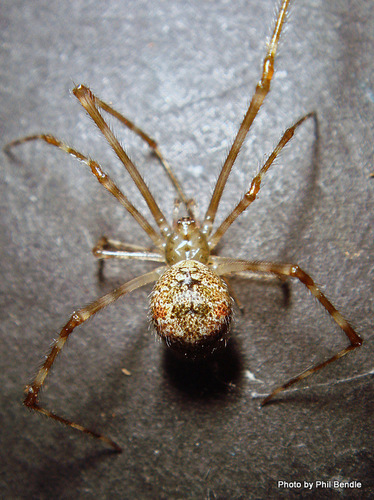
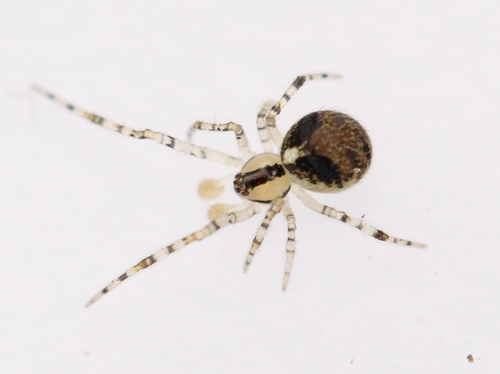
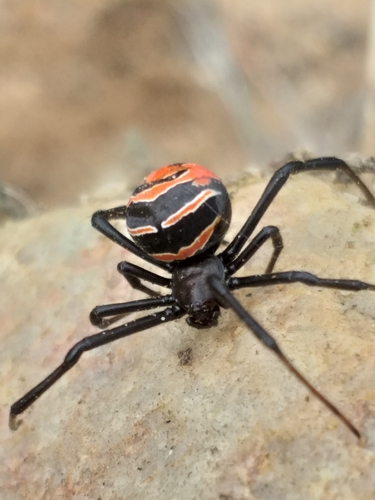
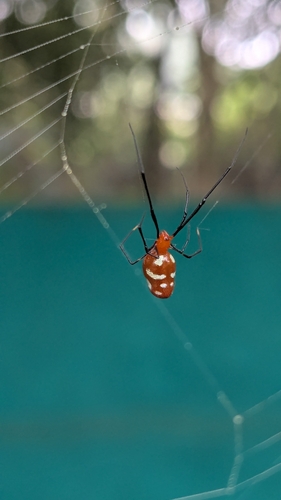
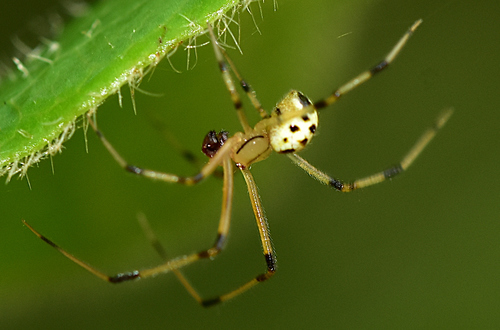
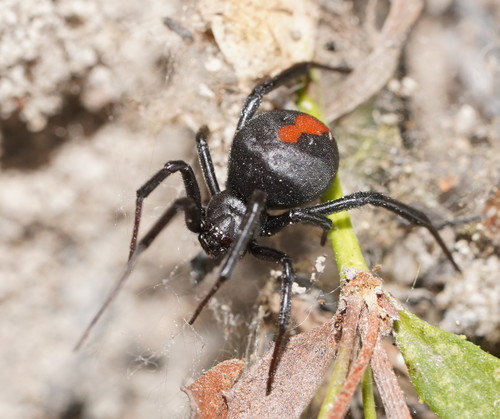
The adult female redback (Latrodectus hasselti Thorell, 1870) has a body around 1 centimetre (0.4 in) long, with slender legs, the first pair longer than the rest. Its round abdomen is deep black, occasionally brownish, with a red (sometimes orange) longitudinal stripe on the upper surface and an hourglass-shaped scarlet streak on the underside. Occasional females have incomplete markings or entirely black abdomens. The cephalothorax is much smaller than the abdomen and is black. Redback spiderlings are grey with dark spots, and darken with each moult. Juvenile females have extra white markings on the abdomen. The bright scarlet red colouring likely acts as a warning to potential predators. Each spider has a pair of venom glands, one attached to each of its chelicerae, with very small fangs. The male redback is much smaller than the female, at just 3–4 mm (0.12–0.16 in) long. It is light brown, with white markings on the upper side of the abdomen and a pale hourglass marking on the underside. Another Australian species with a similar build, Steatoda capensis, is called the "false redback spider", but it is uniformly black or plum-coloured and lacks the red stripe. The redback spider is widespread across Australia. Its current recorded distribution from the World Spider Catalogue also includes Southeast Asia and New Zealand. Colonies and individual redbacks have also been found in Japan, England, Belgium, the United Arab Emirates and Iran. It was once thought redbacks may have been introduced to Australia, because they appeared concentrated around sea ports when first formally described in 1870. However, an earlier informal description from the Adelaide Hills dating to 1850 is now documented, and names for the spider in Australian Aboriginal languages confirm it was present long before European settlement. Its original range is thought to have been a relatively small arid area of South Australia and Western Australia. Its spread has been accidentally aided by modern buildings, which often provide habitats suitable for redback populations. The close relationship between the redback and New Zealand's katipō also supports that both species are native to their respective ranges. Outside urban areas, redbacks are most often found in drier habitats ranging from sclerophyll forest to desert, including the harsh environment of the Simpson Desert. They became far more common in urban areas in the early decades of the 20th century, and are now found in all but the most inhospitable environments across Australia and its cities. They are particularly common in Brisbane, Perth and Alice Springs. They are widespread throughout urban Australia; observations from at least the 1970s, and likely earlier, note that most suburban backyards in Canberra, for example, host one or more nesting females in sites such as firewood piles, stored brick stacks, around unused or restored motor vehicles, and generally behind sheds. Redbacks are commonly found close to human residences. Their webs are usually built in dry, dark, sheltered sites, such as among rocks, in logs, tree hollows, shrubs, old tyres, sheds, outhouses, empty tins and boxes, children's toys, or under rubbish or litter. Letterboxes and the undersurface of toilet seats are common web sites. Redback populations can be controlled by clearing these habitats, squashing spiders and their egg sacs, and using pesticide in outhouses. The CSIRO Division of Entomology recommends against using spider pesticides for redback control, due to the pesticides' toxicity and because redbacks rapidly recolonize areas after treatment. Spiders identified as L. hasselti based on morphology were recorded in the French Pacific territory of New Caledonia in 1920. Their behaviour differs from Australian redbacks: they do not practice sexual cannibalism, and are less likely to bite humans. The first recorded envenomation by L. hasselti in New Caledonia occurred in 2007. Spiderlings hatch from their eggs after around 8 days, and can emerge from the egg sac as early as 11 days after being laid, though cooler temperatures can slow their development significantly, delaying emergence for months. After hatching, they spend around a week inside the egg sac, feeding on yolk and molting once. Baby spiders emerge from September to January, which is spring to early summer in the region. Male spiders mature through five instars in around 45–90 days. Females mature through seven to eight instars in around 75–120 days. Males live for up to six or seven months, while females live between two and three years. Laboratory tests show redbacks can survive an average of 100 days without food, and sometimes over 300 days. Starved redbacks kept at 10 °C (50 °F) survive better than those kept without food at 25 °C (77 °F). Redbacks reduce their metabolic rates in response to starvation, and can distend their abdomens to store large amounts of food. They can survive temperatures from below freezing to 40 °C (104 °F), though they require relatively warm summers with temperatures of 15 to 25 °C (59 to 77 °F) for two to three months to survive and breed. Redback spiderlings cohabit on their mother's web for several days to a week, during which sibling cannibalism is often observed. They then leave by being carried on the wind. They move toward light and climb to the top of nearby logs or rocks before raising their abdomens high and producing a droplet of silk. The liquid silk is drawn out into a long gossamer thread that, once long enough, carries the spider away. This behaviour is called ballooning or kiting. Eventually, the silken thread sticks to an object, where the young spider builds its own web. They sometimes behave cooperatively, climbing, releasing silk, and being carried away in clusters. Juvenile spiders build webs, sometimes alongside other spiders. Before a juvenile male leaves its mother's web, it builds a small sperm web. It deposits sperm from its gonads onto the web, then collects the sperm back into each of its two palps, its copulatory organs, because the gonads and palps are not internally connected. After molting into its final instar, the male wanders off to search for a female. The male does not eat during this search period. How males locate females is unclear, and it is possible they balloon like juveniles. A Western Australian field study found most males take 6 to 8 weeks to travel around 3 to 3.5 metres (9.8 to 11.5 ft), with occasional journeys over 8 m (26 ft), and only around 11–13% successfully find a mate. Males are attracted by pheromones that unmated, sexually mature female redback spiders deposit onto their webs; these pheromones include a serine derivative (N-3-methylbutyryl-O-(S)-2-methylbutyryl-L-serine). This is thought to be the only method males use to assess a female's reproductive status, and courtship involves dismantling much of the pheromone-marked web. During mating, the male redback attempts to copulate by inserting one of its palps into one of the female's two spermathecae, each of which has its own insemination orifice. It then often succeeds in inserting its other palp into the female's second orifice. The redback spider is one of only two known animals where the male actively assists the female in sexual cannibalism. During mating, the much smaller male somersaults to place its abdomen over the female's mouthparts. In around two out of three cases, the female fully consumes the male while mating continues. Males that are not eaten die from their injuries soon after mating. Mating sacrifice is thought to give two advantages to the species. First, the eating process allows for a longer copulation period, and thus fertilization of more eggs. Second, females that have eaten a male are more likely to reject subsequent males. Although this means the male cannot mate again, this is not a major disadvantage: spiders are spread so thinly that less than 20% of males ever find a potential mate during their lifetimes, and the male is functionally sterile after using the contents of both of his palps in his first mating anyway. Some redback males have been observed using an alternative tactic that also ensures more of their genetic material is passed on. Juvenile female redbacks nearing their final moulting and adulthood have fully formed reproductive organs, but lack openings in the exoskeleton that allow access to the organs. Males bite through the exoskeleton and deliver sperm without performing the somersault seen in males mating with adult females. The females then moult within a few days and lay a clutch of fertilized eggs. After the female mates, sperm is stored in one or both of her spermathecae. The sperm can be used to fertilize multiple batches of eggs over a period of up to two years, an estimate based on observations of closely related species. Typically, the female restarts pheromone production to advertise her sexual availability around three months after mating. A female redback may lay four to ten egg sacs. Each egg sac is around 1 cm (0.39 in) in diameter and contains an average of around 250 eggs, though clutch sizes can range from as few as 40 to as many as 500. The female first prepares a shallow concave disc around 3 mm (1⁄8 in) in diameter before laying eggs into it over around five minutes. She then adds more silk to complete the spherical sac; the entire process takes around one and a quarter hours. She can produce a new egg sac as early as one to three weeks after her last.